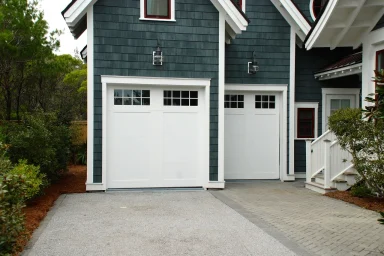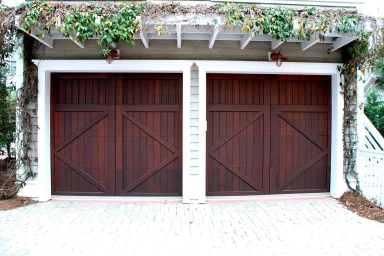
Find what your garage door is doing below. Each of the six sections stands on its own: what you can check yourself, where you stop, and what a trained door technician will look at, from the federal opener rule (16 CFR part 1211), DASMA’s technical sheets and the makers’ own manuals, with a link to the full page. One idea runs through all of them: the springs lift the door, not the opener. So before you press the button again, look up.
General information, not professional advice. Your door’s maker, your opener manual and a trained door technician decide what’s safe for your door, and local codes decide what needs a permit.
Stop first if you see any of these
- A loud bang from the garage, or a gap in the coils of a spring above the door.
- A cable hanging loose, frayed or off its drum.
- A door that sits crooked, has a roller out of its track, or is stuck partly open.
Then don’t run the opener or lift the door, keep people, pets and cars clear, don’t pull the red emergency release on an open or partly open door, and call a trained door technician. Every opener manual must carry these warnings (16 CFR 1211.16(b)(2), items 4, 6 and 7, read 10 November 2026):
“NEVER GO UNDER A STOPPED PARTIALLY OPEN DOOR.” “Weak or broken springs may allow the door to fall rapidly, causing injury or death.” “Have a qualified service person make repairs to cables, spring assemblies and other hardware.”
Why the door comes first: DASMA, the door and opener makers’ association, says garage doors weigh “anywhere from 90 pounds to over 500 pounds” (TDS-176, reaff. 6/19) and that you shouldn’t “expect a garage door operator to compensate for a poorly maintained door” (TDS-385, 1/24). So owners check power, controls, the safety sensors and the settings their opener manual gives them. Springs, cables, drums, bottom brackets and bottom rollers stay with a trained door systems technician (DASMA TDS-167, rev. 4/23).
The door won’t open
Press the wall button once and listen. Silence points to power; a wall button that works while the remote doesn’t points to the signal; a motor that runs while the door stays put may mean the opener is disconnected, or the door too heavy for it.
You check
- Power: plug a lamp into the opener’s outlet, and check the fuse or breaker if it stays dark (Genie manual 42598.02135, 10/2024, p. 23).
- The remote against the wall button: if only the wall button works, try the remote’s battery, then its programming by your manual.
- The wall control’s lock: LOCK on Chamberlain and LiftMaster, Sure-Lock on Genie (a flashing blue long light on the motor unit, p. 24).
- A manual lock on the door. If it seems under tension from the door, leave it and stop (DASMA TDS-174, reaff. 4/19).
- Motor runs, door doesn’t: only with the door fully closed and no stop sign above, pull the release, lift by a handle and let go at 3 to 4 feet. Genie says a balanced door “should remain stationary or slowly drift closed” (p. 21). Close it and reconnect by your manual.
Stop if you heard a bang or a cable hangs loose; the motor runs and the door stays put with the opener connected, or the chain or belt is broken; or, once released, the door moves on its own, is too heavy or won’t stay put. Never turn up the force: Genie says “NEVER adjust the force settings to adjust for damage, including an unbalanced door, binding door track or broken spring” (p. 9).
Technician: springs, cables and drums, then the opener’s drive, trolley, travel limits and board.
The full check in order, including power cuts and battery backup: garage door won’t open.
The door won’t close
Often this is the opener obeying the federal rule. It checks its secondary protection, usually photo eyes near the floor, on every close, and if that device is missing or faulty, “an open door shall not close more than 1 foot (305 mm) below the upmost position” (16 CFR 1211.8(c)). One dirty lens can do it.
You check
- The photo-eye lights. On Chamberlain’s 2023 openers both glow steady when lined up; a blinking green light means blocked or out of line (guide 114-5851-000, p. 10). On Genie’s, red blinking twice with green on means the same (p. 18).
- Nothing in the beam, both lenses clean, the eyes lined up by your manual. Low sun straight into the receiving eye can break the beam too.
- The lock: on Chamberlain and LiftMaster openers, main lights flashing twice mean LOCK is on.
- Hold-to-close, only where your manual gives it (Genie p. 23; Chamberlain Group says openers and logic boards made after 3 February 2022 lack it). Watch the whole opening while you hold.
Stop if the door binds, sags or runs crooked in its tracks, or a spring or cable looks wrong. CPSC says doors that aren’t balanced, “or if they bind or stick, they should be serviced by a professional” (Publication 523). Never tape, jumper or re-aim the sensors.
Technician: tracks, rollers, the door’s balance, and the opener’s safety system: sensor wiring and mounting, then travel and force.
Every step, with the lights by brand: garage door won’t close.
The door starts down, then goes back up
Reversing is a safety feature. Except in the first foot of travel from fully open, a closing door must start to reverse within 2 seconds of hitting an obstruction, and an opener that doesn’t track the door’s position must reverse if the door hasn’t reached its down limit within 30 seconds (16 CFR 1211.7(b)). A broken beam, a dragging door or a down limit set short can all send it back up.
You check
- Nothing in the door’s path or the beam: a bin, a broom, leaves, snow.
- The photo eyes clean and lined up, the beam no higher than 6 inches above the floor (DASMA TDS-364, rev. 6/26); CPSC’s Publication 523 says 4 to 6 inches.
- A door that stops short of the floor, or touches it and goes back up: the down travel, set by your opener manual.
- Then the reverse test again: “The garage door MUST reverse on contact with a 1 1/2 inch object (or a 2 by 4 board laid flat) on the floor. After adjusting either the force or the limit of travel, retest the door opener” (1211.16(b)(2), item 5).
Stop if it still fails the reverse test, or closes with the beam blocked: don’t use the opener until it’s fixed. CPSC says to disengage an opener that fails until it is adjusted by the owner’s manual, repaired or replaced; pull the release only once the door is closed.
Technician: door balance, binding hardware, force and travel, and the sensors, then both tests again.
Reading, cleaning and aligning the eyes, and why not to bypass them: garage door safety sensors. The won’t-close page above covers reversing too.
A loud bang, and now the door won’t lift
A bang, then a door that won’t lift or rises a few inches while the opener strains, may mean a spring has broken. Clopay, a door maker, says a broken torsion spring “splits into two separate pieces. Look for a distinct gap in the coil” (Clopay, 5 March 2021).
You check, by looking only, from the floor, never from under an open door:
- A gap in the spring on the shaft above the door, or an extension spring along a side track broken or hanging.
- A cable slack, frayed or off its drum. DASMA: “Do not touch or attempt to adjust or repair the springs or anything to which door spring parts are fastened” (TDS-174).
- Any light or code on the opener, and the model and date on its label.
Stop now. Don’t run the opener or lift the door by hand: Genie says “DO NOT OPERATE garage door automatically or manually if door is improperly balanced or springs are broken” (p. 21). Don’t pull the release on an open door: it can fall. Keep everyone out from under it, and don’t drive through a closed door to free a car (TDS-385).
Technician: both springs (Clopay recommends replacing both on a two-spring door), the cables, drums and bottom brackets, then the balance and the reverse test.
What to do now and what to ask: broken garage door spring. If it’s a cable rather than a spring: garage door cable snapped or loose.
The door is off its track
Off track means one or more rollers have left the metal channel that guides the door: a roller hanging outside, a section tilted, a door crooked in the opening, a bent track. DASMA warns that a door falling out of its tracks is dangerous to anyone under or near it (TDS-176).
You check
- Keep people and cars clear, and don’t run the door again: no remote, wall button, keypad or app. Tell everyone who has one.
- Look from the side with a flashlight, touching nothing: which side is off, a bent track, a loose cable, a gap in a spring (TDS-174, visual inspection).
- Take photos from where you stand; note the opener’s model, date and any flash code.
Stop: a door off its track is already past the stop point. DASMA says that if any problem is seen, the check ends and a trained door systems technician is called (TDS-174, note 3). Don’t push, lift, pry or loosen anything, don’t pull the release, and skip the balance test.
Technician: secures the door and spring system, finds why it left the track, repairs tracks, rollers, cables or springs, then checks the balance, the reverse test and the photo eyes.
The causes, and why not to put it back yourself: garage door off track.
The opener’s light is blinking
A blinking light is the opener’s self-check, and the same count means different things on different models. On LiftMaster and Chamberlain openers with UP and DOWN arrows, count the UP flashes, then the DOWN: 1-1 is a safety sensor problem. Main lights flashing 10 times also point to the sensors; 2 flashes mean LOCK is on (Chamberlain Group, “Diagnostic Codes and UP/DOWN Flashing Lights” and “Light Blinks but The Door Won’t Close”, read 10 November 2026). Genie openers use a round and a long light in colour pairs (p. 24).
You check
- Count the pattern twice; note which light and what colour.
- The model and date on the opener’s label (required since 1 January 1991, 16 CFR 1211.19).
- The photo eyes clean and lined up, and the lock off.
- One power reset where the maker prints it: unplug the opener and any backup battery for 5 seconds. Not for a Genie thermal cutout (long light steady red): wait for it to clear.
Stop if the code comes back after the maker’s own check, or points to the motor, the logic board, another part or cable tension, or leads you to a broken spring, a loose cable or a heavy, crooked door.
Technician: whatever the code points to (board, motor, travel or sensor wiring), usually after checking the door, since a stiff or unbalanced door causes many force and motor-speed codes.
Every code we have read in a maker’s document, with who acts: opener blinking lights and error codes.
Two more problems
The door opens on its own. It has usually been told to. Chamberlain Group and Genie name a stuck button on a remote or wall control, a remote you no longer control, and a shorted wall control; checking every control and clearing the opener’s remote memory are their first fixes. A door that creeps down from open and gets pulled back up is different: Chamberlain says that is most often an unbalanced door, which is technician work. See garage door opens by itself.
The opener isn’t working, or no symptom fits. Decide first whether it’s the opener or the door, then work through power, lock, remote, sensors and travel, brand by brand: garage door opener not working.
After any fix, and before you call
Once the door runs again, test it: the 2 by 4 reverse test, and the photo-eye test, where the door should reverse to fully open when you pass an object through the beam (TDS-364). CPSC asks owners to inspect the door and opener every 30 days. Both tests step by step: garage door safety and the monthly reverse test; the door’s weight check: the balance test.
Before you call a technician, write down the opener’s brand, model and date, the light pattern counted twice, what happened and when, where the door is now, what you saw from the floor and what you already checked. Ask whether it was the door or the opener, whether the cables, drums and bottom brackets were checked, and to see the reverse test pass before they leave. What can’t wait: a broken spring or loose cable with the door open, a door off its track, or a door that won’t reverse. Leave it where it is, keep everyone clear and call.
Sources checked on 10 November 2026: 16 CFR 1211.7, 1211.8, 1211.16 and 1211.19 (eCFR); CPSC Publication 523; DASMA TDS-167, TDS-174, TDS-176, TDS-364 and TDS-385; Genie manual 42598.02135 (10/2024); Chamberlain user’s guide 114-5851-000 (2023) and Chamberlain Group support articles; Clopay’s 5 March 2021 spring article.