If you heard a loud bang from the garage and now the door won’t lift, or the opener hums and strains and the door only rises a few inches, a spring may have broken (our springs and cables guide explains how the whole system works). Stop using the door: don’t press the remote, the wall button or the app, and don’t try to lift it by hand. If the door is open or partly open, keep everyone out from under it and don’t pull the red emergency release. Then call a trained garage door technician. The federal rule for openers and every maker we read send repairs to standard springs, cables and the hardware fastened to them to a qualified or trained technician (Clopay’s own EZ-SET system is the one exception we found, covered below). This page explains what you can look at from the floor, what not to touch and why, what the technician will do, and what to ask.
Stop first
- Don’t run the door. Genie’s current opener manual says “DO NOT operate a door that jams or one that has a broken spring”, and DASMA’s inspection checklist says that if a spring is broken, don’t operate the door until the spring is replaced (Genie manual 42598.02135, 10/2024, p. 2; DASMA TDS-167, rev. 4/23). Tell everyone in the house not to use the remotes, the wall button, a keypad or the app until it is fixed.
- Don’t lift it by hand either. Genie: “DO NOT OPERATE garage door automatically or manually if door is improperly balanced or springs are broken” (Genie manual, p. 21).
- Don’t pull the emergency release on an open door. The federal rule makes every opener manual carry this warning: “if possible, use the emergency release only when the door is closed. Use caution when using this release with the door open. Weak or broken springs may allow the door to fall rapidly, causing injury or death.” (16 CFR 1211.16(b)(2), item 6)
- Keep people, pets and cars clear. The same rule: “NEVER GO UNDER A STOPPED PARTIALLY OPEN DOOR.” (16 CFR 1211.16(b)(2), item 4) Don’t park or walk under a door that is up or part way up.
- Call a trained door technician. Don’t loosen, adjust or remove anything on the springs, cables, drums or the brackets at the bottom corners of the door.
General information, not professional advice. Your door’s maker, your opener manual and a trained door technician decide what’s safe for your door, and local codes decide what needs a permit.
What the federal rule and the makers say
Federal law sets safety rules for residential garage door openers made since 1 January 1993 (16 CFR part 1211), and part of that rule is a set of warnings every opener manual must print, word for word or in “equally definitive terminology” (16 CFR 1211.16(a)(5)). Two of the user warnings are about springs:
“6. For products requiring an emergency release, if possible, use the emergency release only when the door is closed. Use caution when using this release with the door open. Weak or broken springs may allow the door to fall rapidly, causing injury or death.
7. KEEP GARAGE DOOR PROPERLY BALANCE. See user’s manual. An improperly balanced door could cause severe injury or death. Have a qualified service person make repairs to cables, spring assemblies and other hardware.”
16 CFR 1211.16(b)(2), eCFR, read 10 November 2026 (“BALANCE” is the rule’s own spelling)
The makers we read go further than the minimum wording:
- Genie (belt and chain drive manual 42598.02135, 10/2024): “DO NOT try to remove, repair or adjust springs or anything to which door spring parts are fastened”, repairs and adjustments are for “a trained service representative using proper tools and instructions” (p. 2), and “NEVER try to repair door hardware or springs yourself” (p. 23).
- Chamberlain (Wi-Fi opener user’s guide 114-5851-000, 2023): “ALL repairs to cables, spring assemblies and other hardware, ALL of which are under EXTREME tension, MUST be made by a trained door systems technician.” (Safety item 11; manuals are listed on Chamberlain Group’s support site.)
- Clopay, a door maker: “Standard torsion spring repair is not a DIY project” and “do NOT attempt this on your own” (Clopay, “Do I Have a Broken Garage Door Spring?”, 5 March 2021).
- DASMA, the door and opener makers’ trade association: if a spring is broken, don’t operate the door until it is replaced, and don’t remove, repair or adjust springs or door parts such as steel brackets and cables; “all repairs and adjustments must be performed by a trained door systems technician using proper tools and instructions” (TDS-167, rev. 4/23; a similar warning for occupants checking a door after damage is in TDS-174, reaff. 4/19).
Signs a spring has broken
The springs do the lifting. DASMA describes the spring system as the counterbalance that “counteracts the weight of a garage door to allow a reduced force to open and close the door” (TDS-160), which is why a small opener motor, or a person, can move a heavy door. When one breaks, the weight comes back. The usual signs:
- A loud bang from the garage. Clopay describes it as a very loud “POP-bang-gunfire sound”, and says springs tend to break most often in cold weather and while the door is down, “because that’s when it’s under the most tension” (Clopay blog, 5 March 2021). That is one maker’s observation, not a rule.
- A gap in the spring above the door. On a torsion spring, Clopay says, “A broken torsion spring splits into two separate pieces. Look for a distinct gap in the coil.” (same blog) It is often visible from the floor.
- The opener strains but the door barely moves. The motor runs, the door rises a few inches or not at all, then stops or goes back down. Genie’s troubleshooting table sends a door that starts up but stops before it is open to the springs and balance, with “NEVER try to repair door hardware or springs yourself” (Genie manual, p. 23).
- A flashing light on the opener. On the Genie openers covered by the 2024 manual, the long LED flashing red with the round LED off can mean “Door contact in UP or DOWN travel” or “Door component failure detected”, and Genie lists the door spring among the things to check (p. 24). Check by looking only. Other brands use other codes: look yours up in our opener code lookup.
- A slack or hanging cable, or a door that sits crooked. These are stop signs in their own right. See what a snapped or loose cable means, and if a roller has left the track, the off-track page.
If you aren’t sure whether a spring is broken, treat the door as if it is. The balance test that owners normally use to check springs starts by pulling the release and lifting the door by hand, and Genie says not to operate a door manually when springs are broken. A known broken spring is not the time for that test; the balance test page explains when it is.
Torsion or extension: tell from the floor
Residential doors use one of two kinds of spring, and DASMA’s inspection checklist tells them apart by where they sit (TDS-167, item 3; definitions from DASMA TDS-160, rev. 1/19):
| Torsion spring | Extension spring | |
|---|---|---|
| Where it is | On a metal shaft across the wall just above the door opening | Along each horizontal track, from near the front of the opening toward the back of the garage |
| How it works | Twisted (wound) around the shaft; it turns the shaft and the cable drums at each end | Stretched; it pulls on cables that run over pulleys to the door |
| What holds a broken spring | The shaft runs through it (DASMA: the shaft “inherently provides containment”) | A containment cable threaded through the centre of each spring |
| A break looks like | A gap between two pieces of the coil (Clopay) | A spring in pieces or hanging loose; the containment cable is there to hold it |
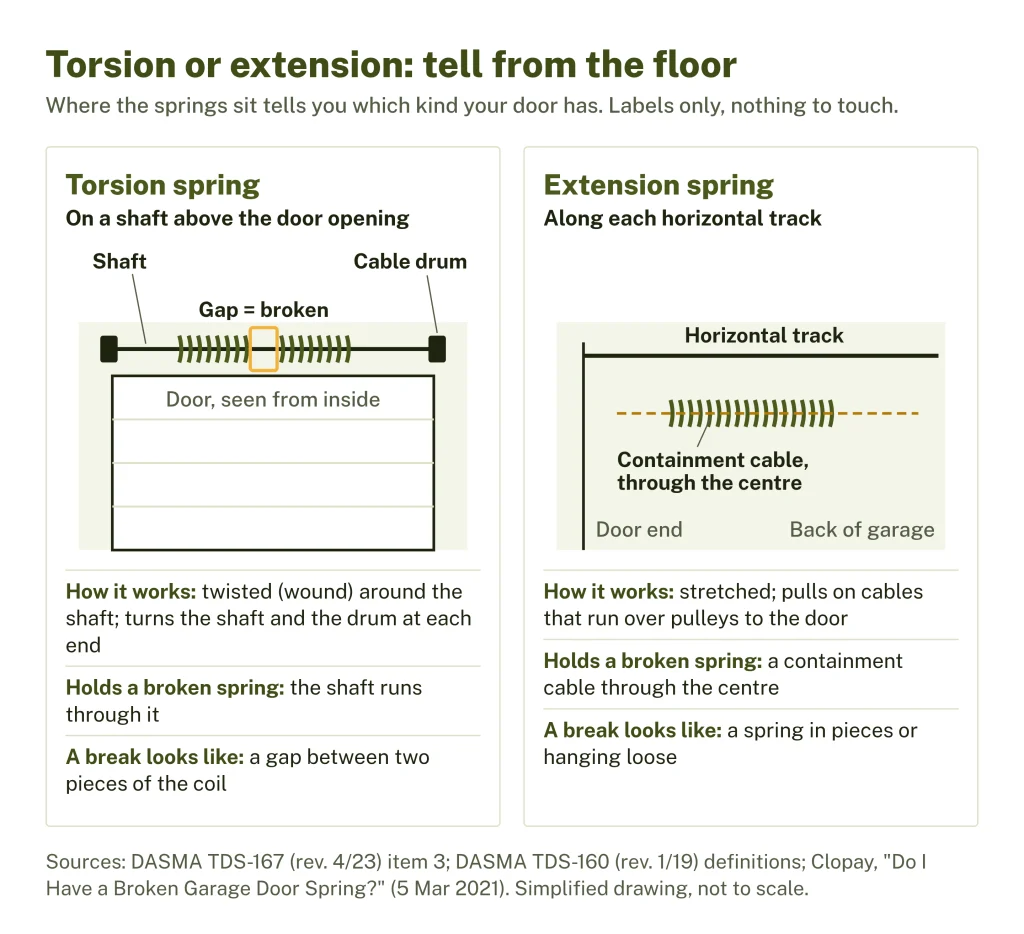
A door may have one torsion spring or two; Clopay shows a 16 by 7 foot door with two (Clopay blog, 5 March 2021). Wayne Dalton makes an enclosed torsion system, TorqueMaster; we have not read its owner documents, so we give no steps for it, and a break in an enclosed spring may not be visible from the floor. The stop rules are the same. Extension springs sit next to the horizontal tracks (TDS-167), and DASMA’s colour chart counts two extension springs per door (DASMA TDS-171). If an extension spring has broken and you can see no cable running through the spring on either side, tell the technician: DASMA’s checklist asks for that cable on every extension-spring door. More detail is on torsion vs extension springs.
You check, stop, technician
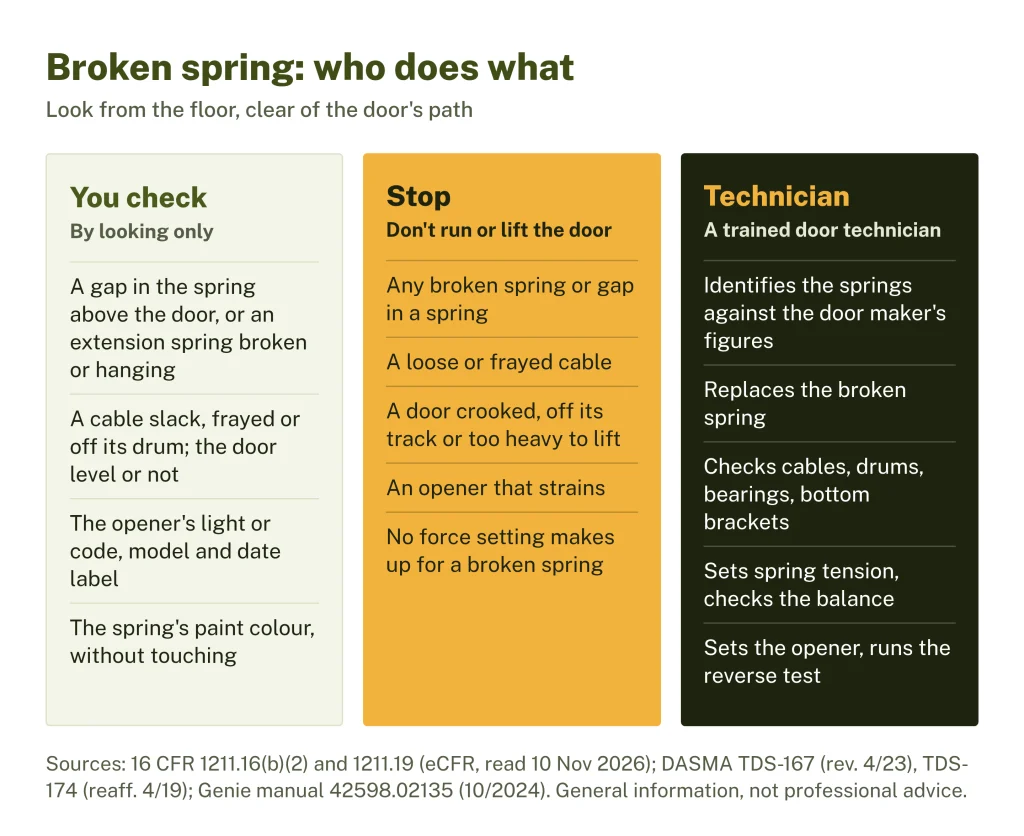
You check (by looking, from the floor)
- Whether the spring above the door has a gap, or an extension spring along a track is broken or hanging. Look from a spot clear of the door’s path, never from under an open door. DASMA’s damage check for occupants is a visual one: “Look for loose cables or any apparent loosening of any other component of the spring system. Do not touch or attempt to adjust or repair the springs or anything to which door spring parts are fastened” (TDS-174, visual step 7).
- Whether a cable is slack, frayed or off its drum, and whether the door sits level. Look only.
- Whether the opener shows a light or code, and the opener’s model and date label. Openers made since 1 January 1991 carry the month or week and year of manufacture (16 CFR 1211.19).
- What colour the spring is painted, if you can see it without touching. That is only partial identification (see below).
Stop
Any broken spring, a gap in a spring, a loose or frayed cable, a door that is crooked, off its track or too heavy to lift, or an opener that strains. From here, nothing gets loosened, wound, unwound, clamped or adjusted by anyone but a trained door technician. That includes the set screws on the cable drums, the bolts on the brackets at the bottom corners of the door, and the spring cones on the shaft. No force setting on the opener makes up for a broken spring: Genie says “NEVER adjust the force settings to adjust for damage, including an unbalanced door, binding door track or broken spring” (Genie manual, p. 9).
Technician
Identifies the springs against the door maker’s figures, replaces the broken spring (Clopay recommends replacing both on a two-spring door), checks cables, drums, bearings and bottom brackets, sets the spring tension the door maker specifies, checks the balance, then sets the opener and runs the reverse test. Each step is explained below.
If the door is stuck open, or your car is inside
This is the hard part, and the honest answer is that the makers don’t give owners a way round it.
- Door closed, car inside. Genie says not to operate a door with broken springs automatically or manually (manual, p. 21), and DASMA says not to operate it until the spring is replaced (TDS-167). With a broken spring, the person lifting is carrying the weight the spring used to carry. DASMA says garage doors weigh “anywhere from 90 pounds to over 500 pounds” (TDS-176, reaff. 6/19), and Clopay says a door “can weigh up to 400 pounds” (Clopay installation page). Plan other transport, and when you call, say the car is shut in. Don’t drive through the door: DASMA warns that collapsing a garage door releases the “stored tension in the door counterbalance system, potentially putting both the vehicle and its occupants at risk” (TDS-385, 1/24).
- Door open or part way up. Leave it where it is. Don’t pull the release (16 CFR 1211.16(b)(2), item 6), don’t press the button to close it, and don’t walk, park or let children play under it (item 4). CPSC warns that “A severely unbalanced garage door could unexpectedly crash to the floor possibly striking someone under the open door” (CPSC Publication 523). If it is open overnight, keep the house door from the garage locked and tell the technician the door is stuck open.
- Getting out of the house. Until the spring is replaced, use another door. Don’t count on lifting this one by hand in a hurry.
Why springs, cables and bottom brackets are off limits
A torsion spring is wound: it is twisted round the shaft by a set number of turns so that it stores enough energy to lift the door. That energy goes through the shaft to a grooved cable drum at each end, and from each drum a lifting cable runs down the side of the door to the bottom bracket, the fitting at each bottom corner that holds the bottom roller and can also anchor the lifting cable (DASMA TDS-160 definitions). When one spring breaks, the rest of the system can still be under load: Genie’s manual warns that door hardware (“springs, cables, brackets, pulleys, etc.”) is “under extreme pressure and tension” (Genie manual, p. 21). Clopay warns that conventional bottom brackets “are under extreme tension and can cause serious injury if deliberately or accidentally loosened or removed by someone inexperienced” (Clopay safety checklist), and Genie’s manual reprints DASMA’s warning: “Do not loosen or adjust any bottom brackets, red colored fasteners, cables, or supports” (Genie manual, p. 30).
Winding is the part the makers single out. Clopay says “Manual winding of a torsion spring during garage door installation or adjustment is extremely difficult and potentially dangerous” (Clopay safety checklist). That is why this site describes the job but doesn’t give steps for it.
What the technician does
Knowing the job helps you follow the quote and spot a visit that skips something. It is not a set of instructions.
- Identifies the springs. A torsion spring is described by its wire size, inside diameter, length and the direction it is wound. DASMA’s official colour codes mark torsion springs by wire diameter and extension springs by door weight, but DASMA warns that colour “provides only partial identification” and that colour codes “should be substantiated by physical spring measurements, door weights, and other information as recommended by the door manufacturer” (TDS-171, reaff. 5/23). DASMA’s spring life sheet adds that the installer should check the spring against the door maker’s installation instructions, because a spring that doesn’t meet the door’s counterbalance requirement can shorten the life of the door assembly or the opener and can create a safety issue when the door is operated by hand (TDS-190, reaff. 2/21).
- Releases the tension and removes the broken spring. On a torsion system, each spring has a winding cone at one end, which the technician turns with winding rods (solid rods made to fit the cone) to wind or unwind the spring, and a stationary cone fixed to the centre bracket (TDS-160). This is the step the makers reserve for a trained technician.
- Checks the rest of the counterbalance system: cables for fraying, drums, the centre and end bearings, the shaft, the bottom brackets and rollers. Clopay says frayed cables are “in danger of breaking” and should be inspected “immediately by a garage door repair professional” (Clopay safety checklist).
- Fits and winds the new spring with the number of turns, and in the direction, the door maker’s instructions specify. DASMA lists too many turns, too few turns and winding backwards among the installation faults that shorten spring life (TDS-190).
- Checks the balance. With the opener released, a balanced door stays put part way up. DASMA’s checklist asks whether the door stays 3 to 4 feet above the floor (TDS-167, items 6 and 11), and Genie’s manual says it “should remain stationary or slowly drift closed” (p. 21).
- Reconnects and sets up the opener by its manual, then runs the reverse test. The federal warning: “The garage door MUST reverse on contact with a 1 1/2 inch object (or a 2 by 4 board laid flat) on the floor. After adjusting either the force or the limit of travel, retest the door opener.” (16 CFR 1211.16(b)(2), item 5)
The full job, including the tools and the risks, is on replacing torsion springs: what a technician does.
Questions to ask the technician
- Will you replace both springs, or one? Clopay recommends replacing both on a two-spring door, “even if one is not broken” (Clopay safety checklist), and says both are wear parts (Clopay blog). If they suggest one, ask why.
- What cycle rating are the new springs? A cycle is one full trip, closed to open and back to closed (DASMA TDS-160). Clopay says “Most garage door springs are designed to last 10,000 cycles” (Clopay blog). DASMA defines a “high cycle spring” as one with increased cycle life for doors used a lot (TDS-160). Ask for the rating on the quote.
- Do the new springs match the door maker’s specification for this door’s weight? (TDS-171, TDS-190)
- Did you check the cables, drums, bearings and bottom brackets? What did you find?
- Is the door balanced now? Ask them to show you that it stays part way up with the opener released.
- Did you run the reverse test after setting the opener? Ask to see it.
- Can I have the spring details in writing? Wire size, inside diameter, length, wind direction and cycle rating, for next time.
What to write down before you call

- What happened and when: the bang, the time, whether the door was open or closed.
- Where the door is now: closed, open or stuck part way, and whether a car is inside.
- Torsion or extension, one spring or two, and which one looks broken.
- The paint colour on the spring, if you can see it from the floor.
- The door’s width and height, and the door maker’s name if a label is visible without touching anything near the springs.
- The opener’s brand, model and date label, and any light or code it shows.
Our spring record tool puts these details on one page you can hand to the technician. It records what you can see; it never sizes a spring or tells you which spring to buy. DASMA says its colour chart “should not be used by homeowners or maintenance personnel to replace garage door springs. Replacement of springs on garage doors should only be performed by a trained door systems technician” (TDS-171).
Why springs break
Springs wear with use. Clopay calls them “wear and tear” parts and says most are designed to last 10,000 cycles (Clopay blog), and every trip up and back down uses one cycle (DASMA TDS-160). DASMA’s sheet on spring life lists what shortens it: the wrong spring for the door, the wrong number of turns, a spring wound backwards, too much or too little stretch, a door made heavier by paint or added parts, doors left open in very hot, cold, wet or salty coastal air, corrosive chemicals, and springs not lubricated “as required in the manufacturer’s instructions” (TDS-190). To see roughly how long a rating lasts at your usage, try our spring cycle-life estimate.
A search of CPSC’s recall database on 10 November 2026 found no garage door spring recall.
Clopay EZ-SET and extension springs
Not every maker draws the line in the same place. Clopay says that with its own EZ-SET torsion spring system, do-it-yourselfers can install or adjust the springs with a 3/8-inch power drill, and that if your torsion door “does not feature Clopay’s EZ-SET Torsion Spring System, contact a garage door repair professional to make adjustments or repairs” (Clopay safety checklist). If your door has EZ-SET, Clopay’s own instructions for your door decide what an owner may do. We have not read those instructions, so we can’t say whether they cover replacing a broken spring, and we give no steps for it. The same goes for extension springs: Clopay supplies its extension springs with containment cables (Clopay safety checklist), and any owner work on them follows the door maker’s own document for that door, not this page. For a standard torsion spring, every maker we read sends you to a technician.
Claims you may see elsewhere
- “Springs last 7 to 10 years.” We found no primary source for a figure in years. What makers state is cycles (Clopay: most springs designed for 10,000), and years depend on how often you use the door.
- “Just pull the release and lift the door by hand.” The federal warning says to use the release with the door closed if possible, and to take care with it open because weak or broken springs can let the door fall (16 CFR 1211.16(b)(2), item 6). Genie says not to operate a door with broken springs by hand at all. Our page on garage door safety and the monthly reverse test covers how the release is meant to be used on a door with good springs.
- “Homeowners can never touch springs.” Too strong as a general statement: Clopay says do-it-yourselfers can install or adjust springs on doors with its EZ-SET system, following Clopay’s own instructions. But for a standard torsion spring, the federal warning and every maker we read say to have a qualified or trained technician do the work.
Your next step
Now: leave the door where it is, tell the household not to use any of the controls, and keep people and cars out from under it. Next: write down the details above, then call a trained garage door technician and say whether the door is open or closed and whether a car is shut in. On the visit: ask about both springs, the cycle rating, the cables, drums and bottom brackets, the balance check and the reverse test. After the visit, test the opener monthly with a 1 1/2-inch object or a 2 by 4 laid flat, as the federal warning asks (16 CFR 1211.16(b)(2), item 5).
Sources checked on 10 November 2026: 16 CFR 1211.16 and 1211.19 (eCFR, up to date as of 6 November 2026); CPSC Publication 523; DASMA TDS-160, TDS-167, TDS-171, TDS-174, TDS-176, TDS-190 and TDS-385; Genie manual 42598.02135 (10/2024); Chamberlain user’s guide 114-5851-000 (2023); Clopay’s safety checklist, installation page and 5 March 2021 spring blog; CPSC’s recall database.
Sources
- eCFR: 16 CFR 1211.16, Instruction manual (required warnings), up to date as of 6 Nov 2026
- eCFR: 16 CFR 1211.19, Statutory labeling requirement (date of manufacture)
- eCFR: 16 CFR part 1211, Safety Standard for Automatic Residential Garage Door Operators
- CPSC Publication 523, Non-Reversing Automatic Garage Door Openers Are a Hazard (009608 Rv0411)
- DASMA TDS-160, Sectional Garage Door Terminology (Rev. 1/19)
- DASMA TDS-167, Residential Sectional Garage Door and Electric Operator Checklist (Rev 4/23)
- DASMA TDS-171, Official Color Codes for Torsion and Extension Springs (5/24/23, Reaff. 5/23)
- DASMA TDS-174, Building Occupant: Checking a Residential Sectional Garage Door for Damage (Reaff. 4/19)
- DASMA TDS-176, Adding Weight to a Garage Door Assembly (Reaff. 6/19)
- DASMA TDS-190, Factors Affecting Spring Cycle Life (Reaff. 2/21)
- DASMA TDS-385, Opening a Motorized Garage Door to Exit a Home in a Power Outage (1/24)
- Genie: Belt/Chain Drive Garage Door Openers Programming, Operation and Maintenance Manual, 42598.02135 (10/2024)
- Chamberlain: Wi-Fi Garage Door Opener User's Guide, 114-5851-000 (2023), via Chamberlain Group support
- Clopay: Do I Have a Broken Garage Door Spring? (5 Mar 2021)
- Clopay: Garage Door Safety Checklist
- Clopay: How to Install a Garage Door