If a lifting cable has snapped, come loose or slipped off its drum, the door has lost one of the lines that tie it to its springs. Leave the door where it is, don’t run it with the opener or by hand, keep everyone out from under it and call a trained door technician. The federal rule for residential openers made since 1 January 1993 requires every opener’s instructions to tell owners, in these words or equally definitive ones, to “Have a qualified service person make repairs to cables, spring assemblies and other hardware” (16 CFR 1211.16(a)(5) and (b)(2); 1211.1), and every door and opener maker we read says the same. This page, part of our springs and cables guide, covers what the cables do, what you can look at from the floor, and what to ask the technician.
Stop first
- Don’t operate the door. Not with the remote, the wall button, a phone app or a timer-to-close, and not by hand. Genie’s opener manual says “DO NOT operate a door that jams or one that has a broken spring”, and DASMA’s damage check for occupants says only trained door systems technicians should repair or adjust a door, and to stop the check if the door is too heavy or difficult to move or won’t stay up (Genie manual 42598.02135, 10/2024, p. 2; DASMA TDS-174).
- Don’t pull the emergency release on an open or partly open door. The federal rule’s own warning: “For products requiring an emergency release, if possible, use the emergency release only when the door is closed. Use caution when using this release with the door open. Weak or broken springs may allow the door to fall rapidly, causing injury or death.” (16 CFR 1211.16(b)(2), item 6). Clopay’s cable guide adds that when cables fray or break, “the door can drop unexpectedly”.
- Keep people, pets and cars clear. “NEVER GO UNDER A STOPPED PARTIALLY OPEN DOOR.” (16 CFR 1211.16(b)(2), item 4). Don’t drive in or out under a door that’s crooked or part-way up.
- Don’t touch the cable, the drum or the bottom bracket. Clopay’s cable guide says “Never touch a broken cable”, and the DASMA guidelines printed in Genie’s manual say “Do not loosen or adjust any bottom brackets, red colored fasteners, cables, or supports” (Clopay, Garage Door Cable Replacement; Genie manual 42598.02135, p. 30).
- Call a trained door technician, and say whether the door is stuck open, closed or crooked.
General information, not professional advice. Your door’s maker, your opener manual and a trained door technician decide what’s safe for your door, and local codes decide what needs a permit.
What garage door cables do
A sectional garage door is heavy: DASMA says doors “can weigh anywhere from 90 pounds to over 500 pounds”, and Clopay’s install page says up to 400 pounds for the doors it describes (DASMA TDS-176; Clopay, How to Install a Garage Door). The springs carry most of that weight, and the cables pass the springs’ force to the door. Clopay describes them as the cables that attach from the spring system to the bottom bracket “on either side” of the door, so there is a lifting cable at each side (Clopay, Garage Door Safety Checklist).
- Bottom bracket. DASMA’s terminology sheet defines it as a structural support on the bottom section that holds track rollers “and may also provide for attachment of lifting cables”. It usually sits at the bottom corners of the door, though DASMA notes other locations are possible (DASMA TDS-160, Rev. 1/19).
- Cable drum (torsion doors). A grooved drum on the torsion spring shaft above the door, “onto which lifting cable is wound when door is opened” (TDS-160). As the torsion spring unwinds, the shaft turns the drums and the cables wind on and lift the door.
- Sheave (extension-spring doors). A pulley that guides the cable. On an extension-spring door the lifting cable runs from the bottom bracket over pulleys, one of them attached to the long spring that runs beside the horizontal track (TDS-160; Clopay’s cable guide: “The cables here run through pulleys attached to the springs”).
- Containment cable (extension-spring doors only). A second, different cable “threaded through an extension spring to retain the spring if it breaks” (TDS-160). It doesn’t lift the door. Torsion springs don’t need one because the shaft they sit on holds them (DASMA TDS-167, Rev 4/23, item 3).
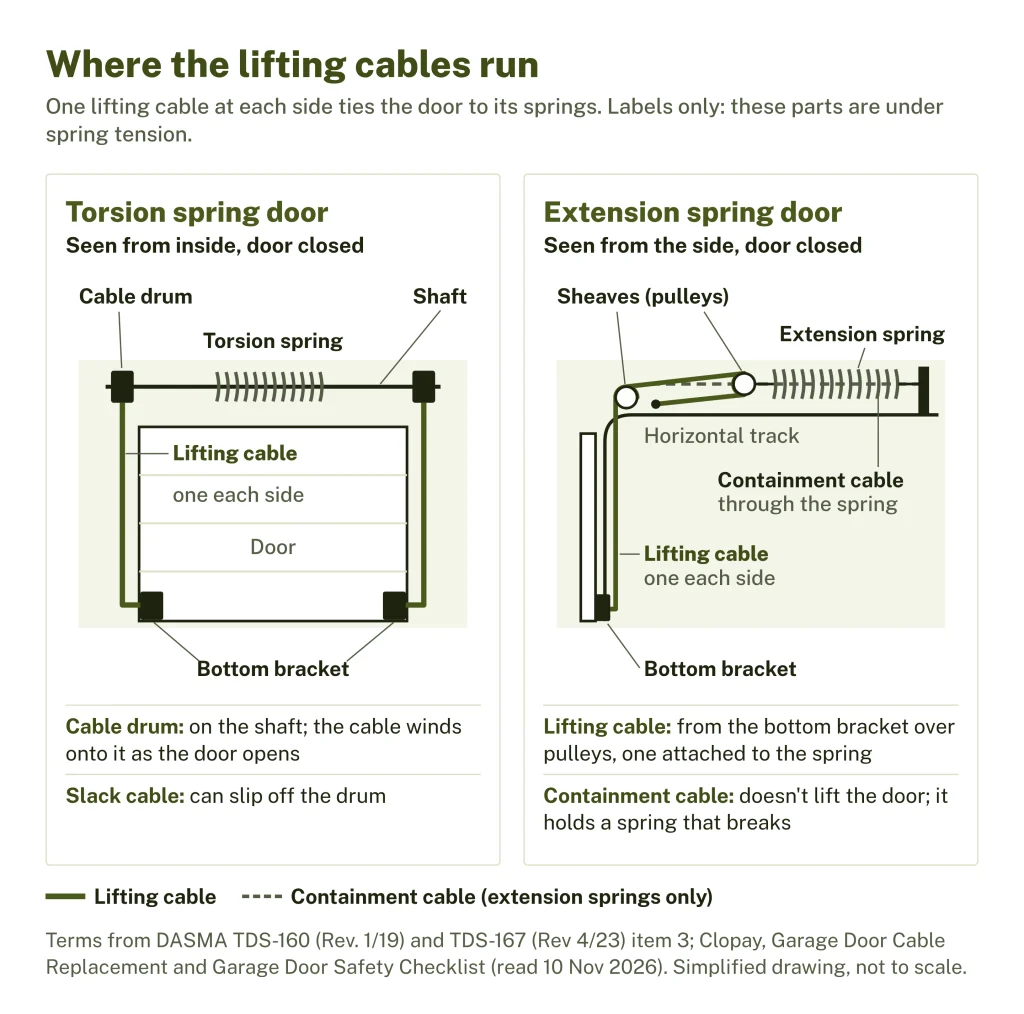
Not sure which spring system you have? Look up from the floor: a spring on a bar above the door opening is torsion; long springs running beside the horizontal tracks are extension springs. Our page on torsion versus extension springs shows both. Some doors also have a “cable safety device”, a bottom fixture DASMA describes as “designed to slow or stop the descent of a door in the event of a cable breakage” (TDS-160). Don’t count on your door having one, and even where one is fitted, a door with a broken cable still goes to the technician.
Snapped, loose, frayed or off the drum: what you’re seeing
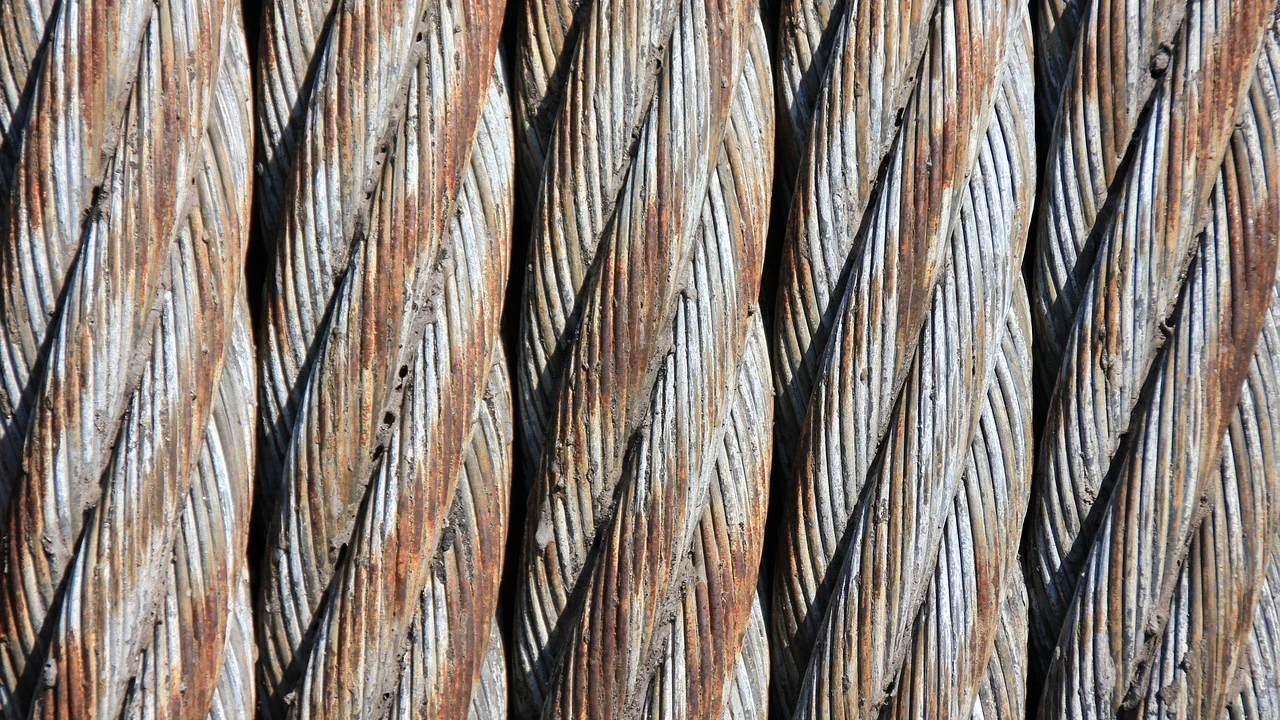
Clopay’s cable guide lists these warning signs: frayed wires or “shaggy” spots, cables splitting into separate strands, slack or sagging cables, rust, corrosion or dark stains, a door that moves unevenly or wobbles, and creaking or snapping noises. It also warns that slack cables “can slip off the drum” (Clopay, Garage Door Cable Replacement, read 10 Nov 2026). Here’s what each one means for you today.
| What you see | What it can mean | Today |
|---|---|---|
| A cable hanging loose, or one in two pieces | The door has lost lift on that side. Clopay: when cables “fray or break, the door can drop unexpectedly or become stuck” | Stop. Don’t run the door. Technician. |
| The door sits crooked, one side lower | One cable is slack, broken or off its drum, or the door is binding in the track | Stop. Don’t try to level it. Technician. |
| A cable that sags or looks slack while the door is still | Clopay: slack cables “can slip off the drum, get tangled, or allow the door to come off its tracks” | Stop. Technician. |
| Cable wound unevenly, or off the groove on a drum | The cable has slipped off the drum; Clopay names slack as one way that happens | Stop. Technician. |
| Frayed or “shaggy” spots, broken strands, rust | The cable is weaker and can break. Clopay: “Have the cables inspected immediately by a garage door repair professional” | Stop using the door. Technician soon. |
| A loud bang, then a door that won’t lift or is very heavy | Clopay’s broken-spring article describes a very loud bang when a spring breaks; check for a broken spring as well as the cables | Stop. See our broken spring page. Technician. |
| Extension springs with no cable through the middle, or a loose one | The containment cable that holds a breaking spring is missing or off. DASMA’s checklist treats this as a fail | Don’t run the door. Technician. |

A door that is crooked, has come out of its track or is twisted needs the same stop. Our door off its track page covers that case, and it often comes with cable trouble.
Why a cable goes loose or breaks
You can’t tell the cause from the floor, and neither can we from a description. These are the causes the makers and DASMA name:
- Wear and rust. Clopay says the constant winding and unwinding wears cables, “especially at points where they rub against drums or pulleys”, and lists rust and corrosion among the signs.
- Something else in the system. Clopay’s guide says a technician can find the problem behind a cable failure, naming “worn pulleys, misaligned tracks, or issues with the springs”. When a cable has gone slack rather than snapped, ask the technician what made it slack.
- An opener’s travel set too far. Genie’s manual warns owners setting the open limit not to adjust it so far that the door “will bend or buckle or stretch door spring cables” (Genie manual 42598.02135, 10/2024, p. 8). If anyone changed the opener’s limits recently, tell the technician.
- A wall-mounted (jackshaft) opener on standard track. These openers turn the torsion shaft instead of pulling the door with a trolley, so they depend on the cables staying tight. DASMA says cable tension comes mainly from the door’s weight and is lowest when the door is open, and warns that without the makers’ guidance, these installations “can result in cable slack and disengagement, leading to uncontrolled door movement, door damage, severe injury, or death” (DASMA TDS-1501, 12/08/22).
If you have a LiftMaster or Chamberlain wall-mount opener, Chamberlain Group’s support article lists code 3-5 (“Cable Tension Monitor”) on its 8500W/RJO70, 98022/RJO101 and 98032 wall-mount jackshaft openers: the monitor may be disconnected, out of position or damaged, or it may be detecting a loose cable, and the door starts closing and goes back up, or doesn’t move. It says that if the cable looks “loose, frayed, damaged, or off the drum”, stop using the door and contact a garage door professional (Chamberlain Group, Diagnostic Codes and UP/DOWN Flashing Lights, read 10 Nov 2026). Our opener code lookup has the other codes. Check the label or manual for your model; it decides for your opener.
The owner line: what you check, where you stop
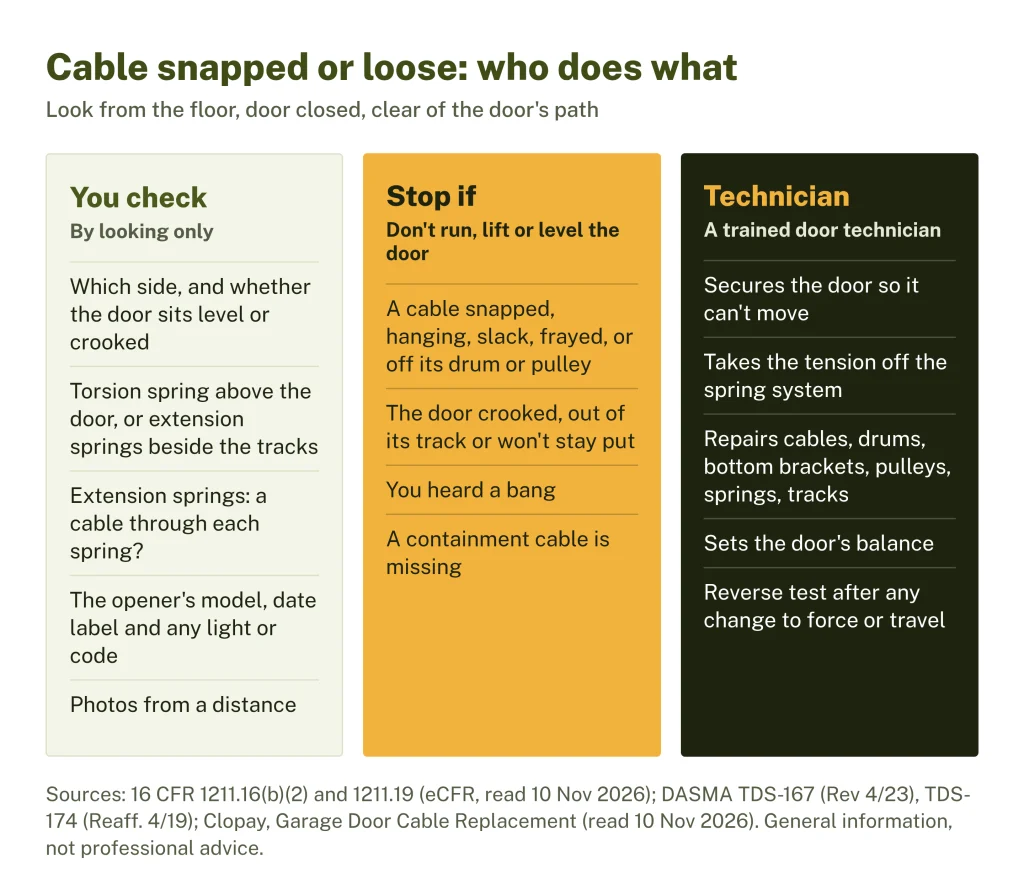
You check (look only, from the floor)
- Look, don’t touch. With the door closed, DASMA’s damage check for occupants says to look for loose cables or any loosening in the spring system, and not to touch or try to adjust or repair “the springs or anything to which door spring parts are fastened, such as wood lag bolts, steel brackets, cables, or other like items” (DASMA TDS-174, visual inspection step 7). If the door is open or part-way up, don’t go under it to look: stay outside its path.
- Note which side, and how the door sits. Left or right (standing inside, looking out), cable hanging or slack, door level or crooked, open, closed or part-way.
- Note the spring type (torsion above the door, or extension beside the tracks) and, on extension-spring doors, whether you can see a cable running through each spring (TDS-167, item 3).
- Note the opener. Its model, and the manufacture date that openers made since 1 January 1991 must carry on the unit (16 CFR 1211.19), plus any flashing light or code. Read them from the floor if you can; don’t climb a ladder next to a door that might move.
- Keep it from being run. Tell everyone in the house, put the remotes away, and don’t use a phone app or timer-to-close until it’s fixed.
- Take photos from a distance. They help the technician bring the right parts.
Stop if
Any cable is snapped, hanging, slack, frayed or off its drum or pulley; the door is crooked, out of its track or won’t stay where it is; you heard a bang; or a containment cable is missing. DASMA’s guidance for occupants: if any problem shows up in the visual check, stop the check, don’t go on to operate the door, and contact a trained door systems technician (TDS-174, note 3).
Technician
Usually secures the door so it can’t move, takes the tension off the spring system with the right tools, then checks and repairs the cables, drums, bottom brackets, pulleys, springs and tracks, and sets the door’s balance. What that involves, and what to ask, is below.
Why cables are technician work, in the makers’ words
A lifting cable on a torsion door is tied into the spring system at both ends: it’s held on the drum above, which the wound spring is turning, and on the bottom bracket below. Clopay’s installation instructions (4150077-R01-0120) warn against loosening any fasteners on springs, cables and bottom fixtures: “You could suddenly release spring forces and risk severe injury.” That’s why the rule and the makers single out cables and bottom brackets, not just springs.
“KEEP GARAGE DOOR PROPERLY BALANCE. See user’s manual. An improperly balanced door could cause severe injury or death. Have a qualified service person make repairs to cables, spring assemblies and other hardware.”
16 CFR 1211.16(b)(2), item 7, the warning every residential opener’s user instructions must carry (the CFR’s own wording, typo included)
- Chamberlain, 2013 manual for the PD612EV and HD420EV: “NEVER try to loosen, move or adjust garage door, door springs, cables, pulleys, brackets or their hardware, ALL of which are under EXTREME tension.” Its 2023 Wi-Fi opener guide (114-5851-000) says repairs to cables, spring assemblies and other hardware “MUST be made by a trained door systems technician” (Chamberlain Group support, manuals).
- Genie, 2024 belt and chain drive manual: “Repairs and adjustments to cables, spring assembly and other hardware must be made by a trained service person using proper tools and instructions” (p. 3), and in its maintenance section, garage door hardware including springs, cables, brackets and pulleys is “under extreme pressure and tension” (p. 21).
- Clopay, installation instructions for its insulated steel sectional doors (4150077-R01-0120, ©2020): “Springs, cables and bottom fixtures are under strong spring tension. Do not attempt to loosen any fasteners on these components.” Its maintenance section adds: “DO NOT loosen or remove bottom bracket with the spring tension engaged.” Clopay’s safety checklist says conventional bottom brackets “are under extreme tension” (Clopay, Garage Door Safety Checklist).
- DASMA, checklist for home inspectors and consumers: don’t try to remove, repair or adjust springs or any door parts or mounting surfaces such as “steel brackets, cables or other like items”; all repairs and adjustments by “a trained door systems technician using proper tools and instructions” (TDS-167, Rev 4/23).
Clopay’s own cable page lists precautions for anyone who removes a cable, but its conclusion is that cable replacement is one of the jobs “that demand specialized tools, training, and a healthy respect for the risks involved”, and it tells owners not to adjust cable tension themselves. We don’t give cable, drum or bottom bracket steps on this site, and no maker document we read gives an owner steps for repairing a broken cable.
One note for extension-spring doors: Clopay’s installation instructions include attaching the lift cables while installing one of its new doors with standard extension springs; that’s for its new doors, by its manual, not a repair of a broken cable on a working door. Our extension springs and safety cables page covers that system.
If the door is stuck open, or your car is inside
- Stuck open or part-way: leave it. Don’t close it with the opener and don’t pull the release (16 CFR 1211.16(b)(2), item 6, above). Don’t walk or drive under it. Tell the technician it’s stuck open when you call: an open garage can’t be locked.
- Stuck closed with the car inside: don’t force it up. DASMA’s damage check says to stop the inspection “If the door is too heavy or difficult to move” (TDS-174), and Clopay warns that a slack cable can let the door come off its tracks. Plan another way to get where you need to go until it’s fixed.
- Crooked: don’t push one side up or down to level it. Keep clear and wait for the technician.
What the technician does
Knowing what’s involved helps you follow the visit and understand the quote. Clopay’s cable guide says professionals “know how to safely release and reset the tension”. No maker document we read sets out the repair step by step, so this is a general outline: on a torsion door, the technician usually keeps the door from moving, takes the tension out of the springs with the proper tools, checks both cables, both drums and both bottom brackets, fits new cable where needed, winds it correctly on the drums, puts the spring tension back and checks the door’s balance. On an extension-spring door, they work on the cable that runs over the pulleys and check the springs, pulleys and containment cables. Either way, a cable failure is a good reason to look at the springs, rollers and tracks too, since Clopay names worn pulleys, misaligned tracks and spring problems as causes.
The opener comes last. The federal rule’s monthly test also says: “After adjusting either the force or the limit of travel, retest the door opener.” (16 CFR 1211.16(b)(2), item 5). A door with a new cable should get its reverse test before you go back to daily use.
What to write down and what to ask
Write down before you call: what happened and when (a bang, a scrape, the door dropping on one side); which side; whether the door is open, closed or crooked; torsion or extension springs; the opener’s model, manufacture date and any code; whether it’s a wall-mounted opener; whether anyone changed the opener settings recently; and your photos.
- Did you check both cables, both drums and both bottom brackets, not only the broken side?
- What made the cable fail or go slack: wear, a spring, a pulley, the track, or the opener?
- Did you check the springs? If a spring is replaced, what is its cycle rating? (Clopay’s broken-spring article says “Most garage door springs are designed to last 10,000 cycles”; one cycle is up and down. Our spring life estimate turns a rating into years at your use.)
- On an extension-spring door: does each spring have a containment cable through it? (DASMA TDS-167, item 3.)
- On a wall-mounted opener: does the door have cable keepers or a tension monitor, as DASMA’s TDS-1501 suggests?
- Is the door balanced now, and did you run the opener’s reverse test after any change to force or travel?
After the repair: catch the next one early
CPSC asks owners to “Inspect the garage door and the garage door opener every 30 days” (CPSC Publication 523). For cables, that means a look from the floor with the door closed: Clopay’s installation instructions list “Worn or frayed cables” in their monthly visual check, and its cable guide suggests checking for fraying, rust, kinks or broken strands about once a month and calling a professional at any slack. Two owner tests from the makers fit alongside it:
- The balance test, started with the door closed: pull the release, lift the door by hand to 3 to 4 feet and let go. Genie says it “should remain stationary or slowly drift closed”; if it moves fast, call a technician (Genie manual 42598.02135, p. 21). Don’t do it while a cable is loose. Our balance test page walks through it.
- The monthly reverse test: “The garage door MUST reverse on contact with a 1 1/2 inch object (or a 2 by 4 board laid flat) on the floor.” (16 CFR 1211.16(b)(2), item 5). See garage door safety for how to run it.
Questions people ask
Does a broken cable mean the spring is broken too?
Not always, but they’re linked: the cable carries the spring’s force, and Clopay names spring problems among the causes behind a cable failure. Ask the technician to check the springs whatever the cable turns out to be. If you heard a bang, read our broken spring page.
I’ve seen videos of people putting a cable back on the drum. Why don’t you show that?
Because none of the primary sources we use gives owners those steps, and all of them say the opposite: the federal rule’s warning, Chamberlain, Genie, Clopay and DASMA all send cable work to a qualified or trained technician. This site gives only the steps a maker or the federal rule gives owners.
Next step: leave the door as it is, keep everyone clear, write down the notes above and call a trained door technician. Mention whether the door is stuck open; that changes how fast you need them.
Sources checked on 10 November 2026: 16 CFR 1211.16 and 1211.19 (eCFR, up to date as of 6 Nov 2026; CPSC’s direct final rule 2026-22213 is scheduled to take effect 29 December 2026, checked 10 Nov 2026, and changes other parts of 1211.16 but not the warnings quoted here), CPSC Publication 523 (Rv0411), DASMA TDS-160, TDS-167, TDS-174, TDS-176 and TDS-1501, Genie manual 42598.02135 (10/2024), Chamberlain manuals 114A4305D (2013) and 114-5851-000 (2023), Chamberlain Group’s diagnostic code article, Clopay installation instructions 4150077-R01-0120 and Clopay’s cable, safety checklist and install pages and its 2021 broken-spring article. The Garage Door Owner.
Sources
- 16 CFR 1211.16, Instruction manual (eCFR, up to date as of 6 Nov 2026)
- 16 CFR 1211.1, Effective date (eCFR)
- 16 CFR 1211.19, Statutory labeling requirement (eCFR)
- CPSC Publication 523, Non-Reversing Automatic Garage Door Openers Are a Hazard (Rv0411)
- DASMA TDS-160, Sectional Garage Door Terminology (Rev. 1/19)
- DASMA TDS-167, Residential Sectional Garage Door and Electric Operator Checklist (Rev 4/23)
- DASMA TDS-174, Building Occupant: Checking a Residential Sectional Garage Door for Damage (Reaff. 4/19)
- DASMA TDS-176, Adding Weight to a Garage Door Assembly
- DASMA TDS-1501, Standard Lift Garage Doors with Jackshaft Operation (12/08/22)
- Genie, Belt/Chain Drive Garage Door Openers Programming, Operation & Maintenance Manual, 42598.02135 (10/2024)
- Chamberlain Group support: garage door opener manuals (PD612EV/HD420EV manual 114A4305D, 2013; Wi-Fi opener guide 114-5851-000, 2023)
- Chamberlain Group, Garage Door Opener Diagnostic Codes and UP/DOWN Flashing Lights
- Clopay, Garage Door Cable Replacement
- Clopay, Garage Door Safety Checklist
- Clopay, How to Install a Garage Door
- Clopay, Do I Have a Broken Garage Door Spring? (5 Mar 2021)
- Clopay, Residential Sectional Insulated Steel Doors Installation Instructions, 4150077-R01-0120 (2020, copy on a retailer's server)