If your garage door has come off its track, stop using it now. Don’t press the remote, the wall button or the app, don’t push or lift the door, and don’t pull the red emergency release. Keep people, pets and cars away from the door and from under it, and call a trained door technician. A door that has slipped out of its track is no longer properly guided, and DASMA, the door and opener makers’ association, warns that a door falling out of its tracks is dangerous to anyone under it. What you can do is look from a distance, take photos and write down what you see, so the technician arrives knowing what happened. This page explains what “off track” means, why it happens, what to look at without touching, and what the technician will do. It is part of our garage door troubleshooting guide.
Right now: stop, secure, call
- Don’t operate the door. No remote, wall button, keypad, phone app, car button or timer. Genie’s 2024 opener manual says plainly: “DO NOT operate a door that jams or one that has a broken spring” (Genie manual 42598.02135, 10/2024, p. 2). Tell everyone in the house, and anyone else who has a remote or the app.
- Don’t pull the emergency release while the door is open or crooked. The federal opener rule requires this warning in the user instructions that come with residential garage door openers: “if possible, use the emergency release only when the door is closed. Use caution when using this release with the door open. Weak or broken springs may allow the door to fall rapidly, causing injury or death” (16 CFR 1211.16(b)(2), item 6). Chamberlain’s 2023 user’s guide puts it this way: weak or broken springs or an unbalanced door “could result in an open door falling rapidly and/or unexpectedly” (114-5851-000, p. 8).
- Keep people, pets and cars clear. Don’t walk or drive under the door, whether it is fully up or stuck part way. The same federal list says: “NEVER GO UNDER A STOPPED PARTIALLY OPEN DOOR” (1211.16(b)(2), item 4). Leave a car that is inside where it is.
- Don’t push, lift, pry or hammer the door or the track, and don’t loosen anything. Springs, cables and the brackets they fasten to are under high tension.
- Call a trained door technician. DASMA says that if any problem is seen during an owner’s check, the check should stop and a trained door systems technician should be contacted (DASMA TDS-174, rev. 4/17, reaffirmed 4/19, note 3).
General information, not professional advice. Your door’s maker, your opener manual and a trained door technician decide what’s safe for your door, and local codes decide what needs a permit.
What “off track” means
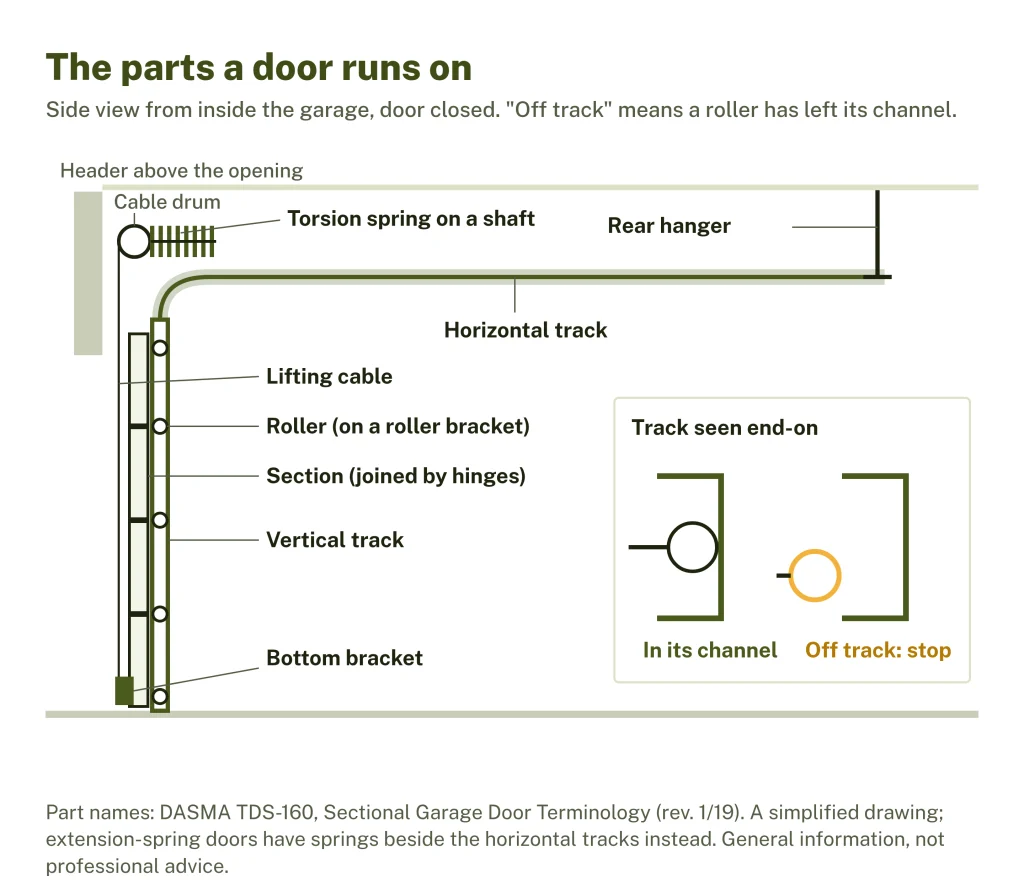
Most home garage doors are sectional doors: several horizontal panels, called sections, joined by hinges. Small wheels called rollers stick out from each side of the door on roller brackets and run inside two metal channels, the tracks. Each track has a vertical part beside the door opening, a curve, and a horizontal part that runs back along the ceiling, held up at the far end by a hanger. DASMA’s terminology sheet defines the track as the channel-shaped rails “in which upward acting doors operate via track rollers” (DASMA TDS-160, rev. 1/19).
The tracks only guide the door. The door’s weight is carried by the counterbalance system: springs (torsion springs on a shaft above the door, or extension springs alongside the horizontal tracks), steel lifting cables, and on torsion systems the grooved cable drums the cables wind onto. Each cable usually ends at a bottom bracket on the lowest section, which DASMA describes as holding track rollers and possibly the cable attachment (TDS-160). The opener only pushes and pulls a door that the springs already balance.
“Off track” means one or more rollers have come out of their channel. You may see a roller hanging outside the track, a section tilted or twisted, a gap between the door and the track on one side, a door that sits crooked in the opening, or a track bent away from the wall or ceiling. Sometimes the door is jammed part way up; sometimes it is fully open and hanging at an angle. Each of these is a stop sign, not a fix-it job. This page is written for sectional doors, the kind DASMA’s damage check covers; a one-piece (tilt-up) door runs on different hardware, but the same stop applies.
Why a door off its track is dangerous
Garage doors are heavy. DASMA says they “can weigh anywhere from 90 pounds to over 500 pounds” and that a door falling out of its tracks is dangerous to people and property under the door or near it (DASMA TDS-176, reaffirmed 6/19). Clopay’s installation page says its doors can weigh up to 400 pounds (Clopay, read 10 Nov 2026).
When the rollers leave the track, the door is no longer guided along the path its springs, cables and track were set up for. DASMA describes doors as “large, heavy objects that move with the help of springs under extreme tension” (TDS-174, note 1), and warns that slack cables can come off and lead to “uncontrolled door movement” (TDS-1501). CPSC, the federal safety agency, warns that “A severely unbalanced garage door could unexpectedly crash to the floor possibly striking someone under the open door”, and that doors which are not balanced, or which bind or stick, “should be serviced by a professional” (CPSC Publication 523, rev. 04/11). The same leaflet says “Hardware and fittings should be checked to keep the door on track at all times.”
The federal opener rule requires every opener’s user instructions to say: “KEEP GARAGE DOOR PROPERLY BALANCE. See user’s manual. An improperly balanced door could cause severe injury or death. Have a qualified service person make repairs to cables, spring assemblies and other hardware” (16 CFR 1211.16(b)(2), item 7, as printed in the eCFR; checked 10 Nov 2026). The makers say the same in their own words:
- Genie (manual 42598.02135, 10/2024): “DO NOT try to remove, repair or adjust springs or anything to which door spring parts are fastened” (p. 2), and in its troubleshooting table, “NEVER try to repair door hardware or springs yourself” (p. 23).
- Chamberlain (Wi-Fi opener user’s guide 114-5851-000, © 2023, safety item 11): “ALL repairs to cables, spring assemblies and other hardware, ALL of which are under EXTREME tension, MUST be made by a trained door systems technician.”
- DASMA’s occupant damage check: occupants should not remove, adjust or repair doors, springs, other door parts or anything they are fastened to, and “Only trained door systems technicians should remove, repair or adjust doors” (TDS-174, note 1).
Why doors come off the track
You usually can’t tell the cause for sure from the floor, and more than one can be at work. These are the ones the primary documents point to:
- Something hit the door or the track. A car bumper, a storm or anything else that bends a panel or a track can leave the door unable to run straight. DASMA’s occupant damage check names high wind, earthquakes and flooding as examples of events that may prompt it (TDS-174, introduction), and says “Any deformation of panels, tracks or hardware can make a door questionable as to its operability” (TDS-174, note 6).
- A broken or slack cable, or a broken spring. The lifting cables run from the spring system to the brackets at the bottom corners of the door, one on each side (TDS-160; Clopay’s checklist). Whether a cable or spring problem pulled the door out of line or came with it, each is a stop sign on its own: DASMA’s checklist says that if a spring is broken, the door should not be operated until the spring is replaced (TDS-167, warning box), and Clopay’s safety checklist says frayed cables are “in danger of breaking”, which “could cause serious injury or property damage” (Clopay checklist, read 10 Nov 2026). See garage door cable snapped and broken garage door spring for those signs.
- Slack cables on a wall-mounted (jackshaft) opener. A jackshaft opener moves the door by turning the shaft above it instead of pulling on the top section, so it depends on the cables staying tight. DASMA warns that on standard-lift track, without the door and opener makers’ guidance, this setup “can result in cable slack and disengagement, leading to uncontrolled door movement, door damage, severe injury, or death” (DASMA TDS-1501, 12/08/22). On LiftMaster and Chamberlain jackshaft models 8500W/RJO70, 98022/RJO101 and 98032, a 3-5 flash code points to the cable tension monitor; Chamberlain’s support article says that if a cable looks loose, damaged or off the drum, stop using the door and contact a professional (Chamberlain Group diagnostic codes article, read 10 Nov 2026). Other codes are in our opener error code lookup.
- A bent, twisted or loose track. DASMA warns that weight added to the door or track, including hanging objects and decorative trim, “can cause the horizontal track to twist, buckle or deform”, which “has the potential to allow the door to fall out of the horizontal track”, and says aftermarket accessories for hanging things from the track should be avoided (TDS-176). Loose track fasteners are on DASMA’s damage checklist too (TDS-174, visual step 4).
- Rollers or their brackets that are worn, loose or binding. DASMA’s checklists ask whether the rollers stay in the track as the door moves and whether roller brackets and hinges are properly attached (DASMA TDS-167, rev. 4/23, item 11d; TDS-174, visual steps 5 and 6). Our garage door tracks guide covers what these parts look like when they are working.
- An opener that kept pushing a door that was binding. An opener’s force setting is not a fix for a sticking door. Genie warns: “NEVER adjust the force settings to adjust for damage, including an unbalanced door, binding door track or broken spring” (Genie manual, p. 9). If someone turned the force up to get a stiff door moving, mention it to the technician.
You check, stop, technician
You check (look only, from a distance)
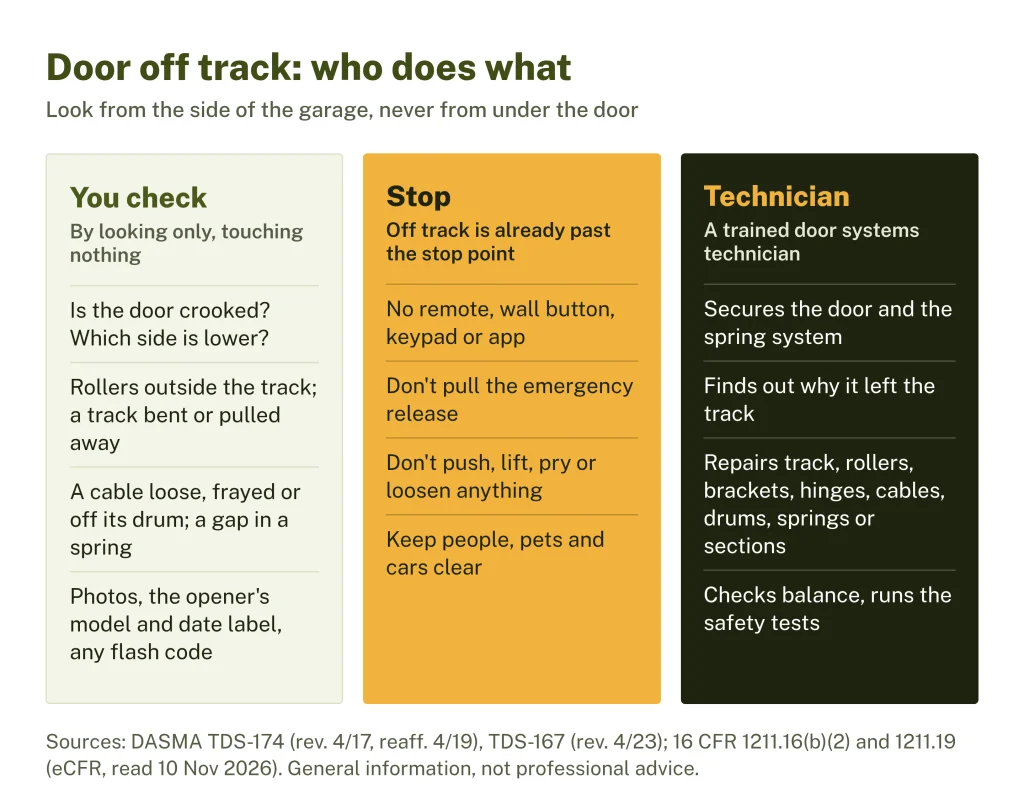
These are the look-only steps from DASMA’s occupant damage check (TDS-174, visual inspection). That check is meant to be done with the door closed; if your door is stuck open or part way, look from the side of the garage, never from under the door, and touch nothing. Use a flashlight.
- Alignment: is the door crooked in the opening? Which side is lower or further out? Any cracked glass?
- Track: are any rollers outside the track? Is either track bent, twisted, or pulled away from the wall or ceiling? Is anything hanging from the track?
- Cables and springs: is a cable hanging loose, frayed, or off its drum? Is there a gap in the coils of a torsion spring, or an extension spring that looks stretched or unevenly spaced with the door closed? Those are the signs of a broken spring Clopay describes. DASMA’s instruction at this step: don’t touch, adjust or repair the springs or anything they fasten to, such as brackets, cables or lag bolts (TDS-174, step 7).
- Hinges and brackets: do any look loose, bent or torn from the door?
- Panels: any cracks, dents or buckling, from inside and outside? On a wood door, splitting around the hardware fasteners can mean structural damage (TDS-174, step 8).
- The frame: are the side jambs and the header above the door still firmly attached? If you’re unsure about the framing the door is fixed to, DASMA says to contact a building contractor or design professional (TDS-174, note 2).
- Record it: take photos from where you stand, and copy the model and the manufacture date from the opener’s label if you can read it from the floor; the federal rule has required the month or week and year of manufacture on openers made since 1 January 1991 (16 CFR 1211.19). If the opener shows a flash code, note the count.
Stop
A door off its track is already past the stop point. DASMA’s damage check says that if any problem is observed, the visual check should end there, the door should not be operated as part of the check, and a trained door systems technician should be called (TDS-174, note 3). So skip the release-and-lift balance check that DASMA and Genie describe for a door that looks normal: it starts by pulling the release, which is exactly what you should not do here. Step back at once if the door shifts or sags while you watch.
Technician
A trained door systems technician secures the door and the spring system, finds out why it left the track, and repairs or replaces what is damaged: track, rollers, brackets, hinges, cables, drums, springs or sections. DASMA says repairs and adjustments are to be done by a trained door systems technician “using proper tools and instructions” (TDS-167). If the framing around the opening is damaged, DASMA points to a building contractor or design professional as well (TDS-174, note 2).
Why not put it back on track yourself?
You’ll find videos and parts-shop pages that show how to open up a track with pliers, ease a roller back in, clamp the door, or loosen the track bolts and tap the track straight. No door maker’s document or DASMA sheet we read gives owners those steps. What they say is the opposite:
- DASMA’s homeowner guidelines, reprinted in Genie’s 2024 manual: springs “are under high tension”, so owners should not loosen or adjust the bottom brackets, the red-coloured fasteners, the cables or the supports; only trained door system technicians should (Genie manual, p. 30).
- DASMA’s inspection checklist: don’t try to remove, repair or adjust springs “or any door parts or mounting surfaces”, including brackets and cables (TDS-167, warning box).
There’s a practical reason as well. The bottom rollers sit in the bottom brackets, which may also be where the lifting cables attach (TDS-160), and those brackets and cables are exactly the parts the makers list as under spring tension. DASMA’s own reason is plain: doors “can cause serious injury or death”, and only trained door systems technicians should remove, repair or adjust them (TDS-174, note 1).
What the technician will look at
Knowing the steps helps you follow the visit and the quote. Expect the technician to:
- Secure the door before moving it. How that is done depends on the door and its spring system, and it is the part of the job the makers keep for trained technicians.
- Check the counterbalance system on both sides: cables (frayed, slack, off the drum), drums, springs and the bottom brackets. Clopay says a broken torsion spring “splits into two separate pieces”, leaving a distinct gap in the coil (Clopay blog, 5 March 2021). If a spring is broken, the spring questions below apply.
- Inspect the track: whether each section can be straightened or should be replaced, whether the fasteners and jamb brackets hold, and whether the rear hangers are secure. DASMA notes that horizontal track that sags or twists when the door is up “should be stiffened with angle braces or back hangs” (TDS-1501, item 6).
- Inspect rollers, hinges, roller brackets and sections, replacing parts that are bent or worn.
- Check the opener and its connection to the door. On a jackshaft opener, they should check the provisions for keeping the cables tight, such as cable keepers or a tension monitor (TDS-1501, items 3 and 7).
- Check balance and run the safety tests before handing the door back (below).
What to ask
- What made it leave the track: impact, a cable, a spring, the track, the rollers, or the opener?
- Were both cables and both drums checked, and are the cables seated in the drum grooves? Were any cables replaced?
- Were the springs checked? If one was replaced, was the other, and what is the cycle rating on the new ones? (Clopay advises replacing both springs together on a two-spring door; checklist, read 10 Nov 2026.)
- Was the track straightened or replaced, and were the brackets and hangers re-secured?
- Was the door’s balance checked afterwards, and was the reverse test run with the opener reconnected?
- Were the photo eyes, if fitted, re-aligned? DASMA says they are typically mounted near the floor on the left and right sides at the bottom of the door opening (TDS-167, item 14), where a crooked door or a bent track can knock them out of line.
- If the door carries a wind-load label, do the replacement parts match the maker’s installation drawing on that label? The 2024 International Residential Code, a model code, asks for a permanent label showing the positive and negative design wind pressure rating and the installation drawing reference number (R609.4.1). Codes are adopted locally; your building department decides.
After the repair
Once the technician has finished and the door runs normally, go back to the routine checks the makers give owners:
- The reverse test. The federal rule’s wording: “Test door opener monthly. The garage door MUST reverse on contact with a 1 1/2 inch object (or a 2 by 4 board laid flat) on the floor. After adjusting either the force or the limit of travel, retest the door opener” (16 CFR 1211.16(b)(2), item 5). If the opener has secondary protection such as photo eyes, check that too. Both tests are on our garage door safety page.
- The balance test, with the door closed first, as in your manual. Genie says a balanced door, released and lifted 3 to 4 feet, should “remain stationary or slowly drift closed” (manual, p. 21). Details: garage door balance test.
- A monthly look. CPSC says to inspect the door and the opener every 30 days (Publication 523). Watch for rollers rubbing or riding up in the track, frayed cables and loose brackets, and call the technician back rather than adjusting anything.
- Nothing hanging from the track. DASMA advises against hanging things from, or attaching anything to, the door or its track without explicit instructions from the door’s maker (TDS-176).
Next step
What can’t wait: a door hanging crooked or stuck open, a loose or snapped cable, or a broken spring. Keep the area clear and call a trained door technician today. If the door is stuck open overnight, lock the door between the garage and the house and leave the garage door alone.

Write down for the technician: what happened and when (a bang, a scrape, a car touching the door, a storm, the opener straining); whether the door was opening or closing; which side is off and where it stopped; anything you saw from a distance (a loose cable, a gap in a spring, a bent track, something hanging from the track); the door’s maker if it’s on a label you can read from the floor; the opener’s model, its manufacture date and any flash code; and your photos. Ask the questions above, including a reverse test with the opener reconnected before they leave.
Sources checked on 10 November 2026: 16 CFR 1211.16 and 1211.19 in the eCFR (title 16 up to date as of 6 November 2026), CPSC Publication 523, DASMA technical data sheets TDS-160, TDS-167, TDS-174, TDS-176 and TDS-1501, Genie manual 42598.02135 (10/2024), Chamberlain user’s guide 114-5851-000 (2023) and Chamberlain Group’s diagnostic codes article, Clopay’s safety checklist, installation page and 5 March 2021 spring blog post, and the 2024 IRC R609.4.1. Makers’ documents describe their own products; check the manual and labels on yours.
Sources
- 16 CFR 1211.16, Instruction manual (eCFR, up to date as of 6 Nov 2026)
- 16 CFR 1211.19, Statutory labeling requirement (eCFR)
- CPSC Publication 523, Non-Reversing Automatic Garage Door Openers Are a Hazard (rev. 04/11)
- DASMA TDS-174, Building Occupant: Checking a Residential Sectional Garage Door for Damage (Rev. 4/17, Reaff. 4/19)
- DASMA TDS-167, Residential Sectional Garage Door and Electric Operator Checklist (Rev. 4/23)
- DASMA TDS-176, Adding Weight to a Garage Door Assembly (Reaff. 6/19)
- DASMA TDS-1501, Standard Lift Garage Doors with Jackshaft Operation (12/08/22)
- DASMA TDS-160, Sectional Garage Door Terminology (Rev. 1/19)
- Genie, Belt/Chain Drive Garage Door Openers Programming, Operation and Maintenance Manual, 42598.02135 (10/2024)
- Chamberlain Group support, Garage Door Opener Diagnostic Codes and UP/DOWN Flashing Lights (read 10 Nov 2026)
- Chamberlain Group support, garage door opener manuals (Wi-Fi Garage Door Opener User's Guide 114-5851-000, 2023)
- Clopay, Garage Door Safety Checklist (read 10 Nov 2026)
- Clopay blog, Do I Have a Broken Garage Door Spring? (5 Mar 2021, read 10 Nov 2026)
- Clopay, How to Install a Garage Door (read 10 Nov 2026)
- ICC, 2024 International Residential Code, chapter 6, R609.4.1 (model code)