Garage door maintenance is a short owner’s routine plus a yearly visit from a trained door technician. Once a month: test that the door reverses when it touches a 2 by 4 laid flat on the floor, test the photo eyes, check the door’s balance by hand with the opener disconnected, and look over the springs, cables, rollers and track without touching anything under spring tension. A few times a year: lubricate what your door’s and opener’s makers name, check the seals and the gap at the floor, and replace remote and backup batteries when they run low. The springs, lifting cables, cable drums and bottom brackets, the parts that hold the door’s weight, are the technician’s part.
This page is the starting point of our maintenance and parts guides. Each task below gets a short answer, the federal rule or maker document behind it, and where the makers disagree. It’s written for the common residential sectional door, the kind that rolls up in panels, with an automatic opener.
General information, not professional advice. Your door’s maker, your opener manual and a trained door technician decide what’s safe for your door, and local codes decide what needs a permit.
You check The monthly reverse test and photo-eye test, the balance check with the door closed first, a hands-off look at springs and cables, lubrication where your maker says, seals, and the remote and backup batteries.
Stop if the door doesn’t reverse, is heavy or won’t stay put when released, runs crooked, binds or leaves its track, or you see a gap in a spring or a loose or frayed cable. Don’t run the door again, keep people and cars clear of it, and call a trained door technician.
Technician Springs, lifting cables, drums, bottom brackets and bottom rollers, spring tension and balance, tightening hardware on parts under tension, bent track, and any reverse failure that resetting the opener’s travel doesn’t cure.
The checklist at a glance
How often comes from the federal rule and from the makers’ own manuals and pages. Where they differ, the table says so. Your own door’s and opener’s manuals decide for your door.
| Task | How often | Who says so | Who does it |
|---|---|---|---|
| Reverse test with a 1 1/2-inch object or a 2 by 4 laid flat | Monthly, and after any force or travel change | 16 CFR 1211.16(b)(2); Genie; Chamberlain | You |
| Photo-eye test | Monthly | DASMA TDS-364 | You |
| Balance check, door closed first | Monthly | Genie; CPSC Pub. 523 (“every 30 days” for the door and opener) | You look; the technician fixes |
| Look at springs, cables, hinges, rollers and track | Monthly to yearly | CPSC Pub. 523; Clopay (at least yearly, up to every three months) | You look; the technician fixes |
| Lubricate rollers, hinges, bearings | Monthly (Genie), yearly (Chamberlain, Clopay’s guide), twice a year (Clopay’s install page) | Each maker | You, where your maker says |
| Sensor lenses and wiring | Monthly | Genie | You clean and look |
| Opener backup battery test | Monthly (Genie), yearly (Chamberlain) | Each maker; DASMA TDS-167 | You |
| Seals and the gap at the floor | Yearly, and in spring and fall | Clopay; DASMA TDS-167 | You check |
| Wash the door | Yearly; more often near salt | Amarr | You |
| Professional inspection | Yearly | Clopay | Technician |
Every month: the reverse test
The federal rule puts this test in every opener manual. Each manual must carry the same warning, word for word or in “equally definitive terminology” (16 CFR 1211.16(a)(5)), under 16 CFR 1211.16(b)(2):
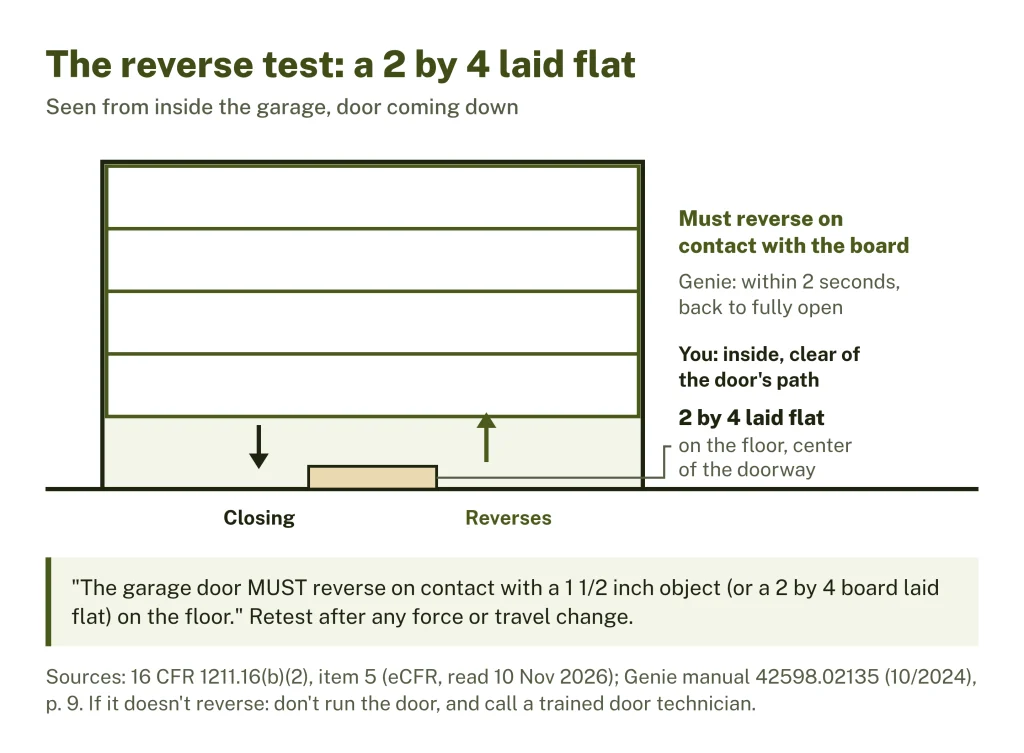
“Test door opener monthly. The garage door MUST reverse on contact with a 1 1/2 inch object (or a 2 by 4 board laid flat) on the floor. After adjusting either the force or the limit of travel, retest the door opener. Failure to adjust the opener properly may cause severe injury or death.”
16 CFR 1211.16(b)(2), item 5
- Do the balance check below first. DASMA’s checklist notes that a door with spring, hardware or section problems may need servicing before this test is run (DASMA TDS-167, Rev. 4/23, item 16).
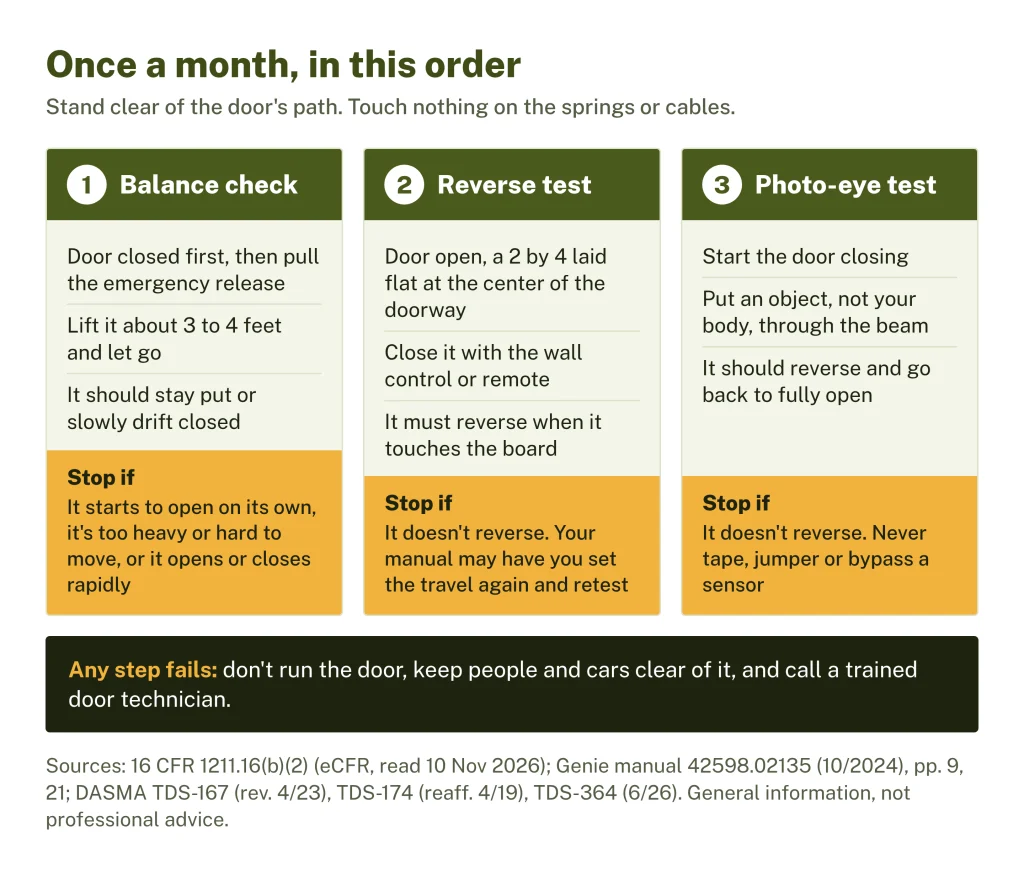
- Open the door fully. Lay a 2 by 4 flat on the floor at the center of the doorway, under where the door closes.
- Stand inside the garage, clear of the door’s path, and close it with the wall control or remote.
- When the door touches the board, it must reverse. Genie’s 2024 manual says it should stop and reverse within 2 seconds to the full open position (Genie belt and chain drive manual 42598.02135, 10/2024, p. 9). DASMA’s checklist asks the same: does the door reverse and return fully open?
If it fails: the makers first send you back to the opener’s travel settings, also called limits, which tell the opener where “closed” is. Genie says a door that stops before the board or doesn’t reverse may have its DOWN limit set wrong: repeat the manual’s DOWN limit and force steps and test again (p. 9). Chamberlain’s 2023 guide says to program the travel again, retest, and if it still fails “call a trained door systems technician” (Chamberlain Wi-Fi opener user’s guide 114-5851-000, © 2023, p. 13). Genie warns never to adjust force to make up for an unbalanced door, a binding track or a broken spring. Until the door passes, CPSC says the opener “should be disengaged until the unit is either adjusted according to the instructions in the owner’s manual, repaired, or replaced” (CPSC Publication 523). The full walk-through, with what each failure means, is in our garage door safety guide.
You may see the test done with a roll of paper towels. That isn’t what the rule says. DASMA says other items “are not recommended by manufacturers or testing agencies” because they aren’t a reliable test (DASMA TDS-369, Rev. 4/2020).
Every month: the photo-eye test
Openers made since 1993 must also have secondary protection, such as photo eyes, the two small sensors near the floor at each side of the door. The federal rule allows a photo eye, an edge sensor on the edge of the door, an inherent sensor or another device giving equivalent protection (16 CFR 1211.8(a)), or a control you must hold down within sight of the door to close it (16 CFR 1211.6(b)), so your door may not have eyes at all. If it does:
- The test. Start the door closing, then put an object through the beam. The door should reverse and go back to fully open (DASMA TDS-364, 6/26; TDS-167 item 15). Use an object, not your body, and stay out from under the door.
- Height. DASMA says the beam should be no higher than six inches above the floor; CPSC Publication 523 says 4 to 6 inches. DASMA gives the reason: so a small child can’t crawl under the beam (TDS-369).
- Cleaning. Genie’s monthly list includes cleaning dirt off the lenses and checking the sensor wiring for loose connections, cracks or worn insulation (2024 manual, p. 21).
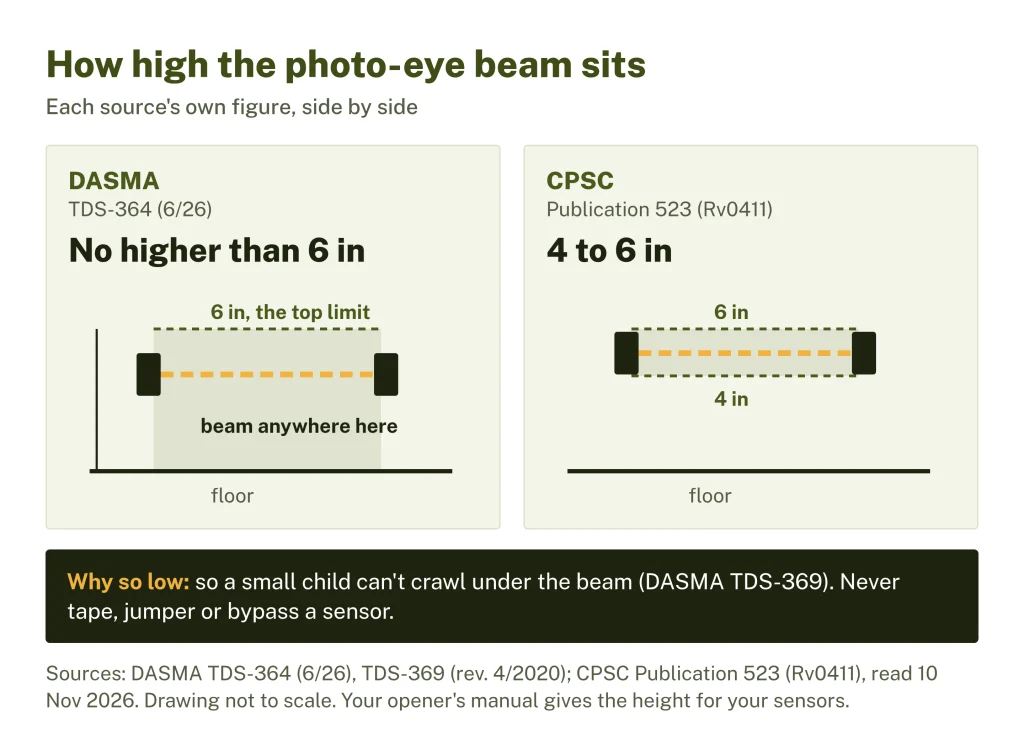
Sensor lights, alignment and sun problems are covered in our garage door sensors guide. Never tape, jumper or bypass a sensor. The opener checks the sensor on every close, and if the sensor is missing or faulty the opener won’t close the door (16 CFR 1211.8(c)).
Every month: the balance check
A balanced door is one the springs hold up. It stays where you leave it when it’s partly open. CPSC: “A severely unbalanced garage door could unexpectedly crash to the floor possibly striking someone under the open door” (Pub. 523). The check uses the emergency release, the red handle hanging from the opener rail, so start with the door closed. The federal warning is plain:
“For products requiring an emergency release, if possible, use the emergency release only when the door is closed. Use caution when using this release with the door open. Weak or broken springs may allow the door to fall rapidly, causing injury or death.”
16 CFR 1211.16(b)(2), item 6
- With the door closed, pull the release to disconnect the door from the opener. DASMA warns the door may begin to open on its own when you do (TDS-167 item 11). If it does, stop.
- Lift the door by its handles or gripping points, keeping your fingers away from the joints between the panels. Lift slowly. If it’s too heavy or hard to move, stop (DASMA TDS-174, Reaff. 4/19).
- Raise it about 3 to 4 feet and let go. Genie: the door “should remain stationary or slowly drift closed”; if it opens or closes rapidly, contact a trained door system technician to have the springs serviced (2024 manual, p. 21). Clopay’s version of the check lifts the door halfway, and a balanced door stays there (Clopay garage door maintenance guide).
- Close the door by hand and reconnect the opener as your manual says. On Genie’s openers you put the carriage back in the engage position and run the opener, and it reattaches itself (p. 21).
An unbalanced door is technician work. Clopay’s maintenance guide says: “Don’t attempt to fix the balance yourself”. Clopay’s installation page uses different wording (“adjust the spring tension or replace the springs”) without saying who should do it, and its own spring pages say standard torsion spring repair is not a DIY project. Read it as a job for the technician. Why an unbalanced door also wears out the opener, and what the result of the check means, is in our balance test guide.
Look at the springs and cables, hands off
Most doors have either torsion springs on a shaft above the opening or extension springs running alongside the horizontal tracks (TDS-167 item 3). The lifting cables run from the spring system down to the bottom brackets at the lower corners of the door. DASMA’s checklist warns that springs and spring hardware are under high tension (TDS-167). Look from the floor, with the door closed, and touch nothing. Federal law makes every opener manual say:
“An improperly balanced door could cause severe injury or death. Have a qualified service person make repairs to cables, spring assemblies and other hardware.”
16 CFR 1211.16(b)(2), item 7
The makers say the same in their own words. Genie: repairs and adjustments to cables, spring assembly and other hardware “must be made by a trained service person” (2024 manual). Chamberlain: “ALL repairs to cables, spring assemblies and other hardware, ALL of which are under EXTREME tension, MUST be made by a trained door systems technician” (114-5851-000). Clopay: “Standard torsion spring repair is not a DIY project” (Clopay, 5 March 2021).
- A gap in a torsion spring, where the coil is split in two, means it’s broken, Clopay says (5 March 2021). Don’t run the door. See broken garage door spring.
- Frayed cables or worn strands hanging loose. Clopay says such cables “are in danger of breaking” and to have them inspected “immediately” by a professional (Clopay safety checklist). A slack or snapped cable is covered in garage door cable snapped or loose.
- Extension springs without a cable through them. Each extension spring should have a containment cable running through its center, so a broken spring can’t fly loose. Torsion springs are held by their shaft (TDS-167 item 3). No containment cable is a technician item.
- Warning labels. DASMA’s checklist looks for a spring warning label on the spring or its bracket and labels near the bottom corner brackets (TDS-167 item 1). Leave them in place. They tell the next person what not to touch.
Clopay says most garage door springs are designed for 10,000 cycles, one cycle being up and down once. To turn that into an estimate of years at your own use, try our spring life estimator. Not sure which kind of spring you have? See torsion vs extension springs.
Lubrication: where the makers differ
Every maker we read asks for lubrication, but they disagree on what, how often and with what. Genie names a light general-purpose grease, Clopay’s maintenance guide says never to use grease, and Chamberlain says to oil the hardware and not to grease the tracks. Follow the maker of your door for the door and the maker of your opener for the opener. DASMA adds that lubricating springs where the maker’s instructions call for it helps them last (DASMA TDS-190, Reaff. 2/21).
| Maker and document | What | How often | Not |
|---|---|---|---|
| Genie, opener manual 42598.02135 (10/2024) | Rollers and hinges, “a light weight general purpose grease” | Monthly | Not stated |
| Chamberlain, guide 114-5851-000 (2023) | “Oil door rollers, bearings and hinges”; white lithium grease on the opener rail where the trolley slides | Yearly; the rail every 2 to 3 years | “Do not grease the door tracks”; the opener itself needs no extra lubrication |
| Clopay, installation page | All moving parts, including the torsion spring’s full length and rollers at the bearing | At least twice a year | Not the roller’s tire |
| Clopay, maintenance guide | Hinges, rollers, sheave bearings, torsion springs; a silicone-based lubricant | Yearly; hinges and rollers again in spring | Not nylon rollers; “Never use grease” |
| Amarr, support page | Moving parts | Regularly | Not plastic parts such as plastic rollers and idler bearings |
Two of Clopay’s points need care. Its lists include the lift cables at the bottom corners of the door, and Clopay’s own pages warn that bottom brackets are under extreme tension and must not be removed while the door is under tension. This site gives no step on cables or bottom brackets, so leave those points to the technician’s yearly visit. Spraying a torsion spring, as Clopay and Amarr describe for a squeaky spring, means spraying only. Never loosen, turn or move anything on the spring. Clopay calls a squeaking or chattering spring “not a safety concern” that a spray-on lubricant can fix. Amarr says to call a professional if the noise continues. Lubricant types and where each goes are in our garage door lubricant guide.
Tracks, rollers, hinges and the panels
- Tracks. Clopay’s guide says to clean the tracks with a small brush and wipe them with a damp cloth. Chamberlain says don’t grease them. A track that is bent, twisted or loose from its hangers goes to a professional, Clopay says. DASMA’s damage check has you look for loose fasteners or misalignment and stop at any problem (TDS-174). See garage door tracks, and if a roller has come out, garage door off track.
- Rollers. They should roll smoothly and quietly and stay in the track all the way up and down (Clopay; TDS-167 item 11). Lubricate them as your maker says, leaving out the bottom rollers: they sit in the bottom brackets, so lubricating or replacing them is technician work. See garage door rollers.
- Hinges and hardware. Look for bent or broken hinges and loose bolts with the door down (Clopay installation page). Clopay’s guide lists tightening loose hardware as an owner task, but it recommends a professional for replacing hinges, and it warns about bottom brackets under tension. Our line: look, note what’s loose, and leave the tightening to the technician, because a bracket or bolt may hold a part under spring tension.
- Panels. From inside and outside, with the door closed, look for fatigue, cracks or layers separating (TDS-167 item 4). Clopay says to check wood doors yearly for cracking, peeling paint or fading, and that steel, composite and aluminum doors don’t need repainting unless you want a new color.
- Washing. Amarr says to wash a steel or aluminum door’s outside once a year with household detergent in warm water, more often near salt air or where salt is used on the driveway, and never to pressure-wash it (Amarr care and maintenance).

Unsure what a part is called? Our garage door parts guide names each one.
Seals and the gap at the floor
When the opener closes it, the door should rest on the floor with no gap (TDS-167 item 12). A gap lets in water and pests, and it also matters for safety: DASMA notes that gaps between the door and the floor stop the reverse systems from working properly across the width of the door (TDS-369). Clopay’s checks for the bottom seal: look for cracks or wear, and run your hand along the bottom of the closed door to feel for a draft. Clopay suggests checking seals in spring and again before winter. What the seal types are and how replacements fit is in our garage door seals guide.
The opener: batteries, buttons and age
- Remote batteries. Both Genie’s and Chamberlain’s current manuals use a CR2032 coin cell. Check your remote. Genie’s manual warns that new and used coin cells must be kept out of reach of children. If a remote stops working after a new battery, see universal garage door remotes.
- Battery backup. If your opener has one, test it with the door closed: unplug the opener and run the door both ways with the wall control or remote (TDS-167 item 17). Genie lists this monthly; Chamberlain yearly. DASMA says backup batteries need replacing after 2 to 5 years, depending on use and type (DASMA TDS-385, 1/24). Chamberlain’s status light turns solid red when the battery won’t hold a charge. More in opener battery backup.
- The drive. Genie asks for a yearly look at the chain or belt for too much slack (p. 21). Follow your manual’s own steps for any adjustment.
- Wall button and release. The installation rule puts the wall control in sight of the door, away from moving parts and at least 5 feet above the floor, and the emergency release “within reach, but at least 6 feet above the floor” (16 CFR 1211.16(b)(1), items 6 and 4). If a child can reach the button, ask the technician about moving it.
- A blinking light or code. Look it up in our opener error code lookup before you assume anything has failed.
How old is your opener? Openers made since 1 January 1991 carry their month or week and year of manufacture on the unit (16 CFR 1211.19). CPSC requires that openers made or imported for sale after 1 January 1991 reverse, and added the external entrapment protection requirement in 1993 (Pub. 523). The federal standard applies to openers “manufactured on or after January 1, 1993” (16 CFR 1211.1). An older opener may not reverse, and CPSC urges owners of openers that don’t reverse to repair or replace them (Pub. 523). The federal rule covers how openers are made from 1993 on, and DASMA notes that no federal law prohibits repairing an older opener (DASMA TDS-351, Rev. 1/24). An update to the federal standard, adding tests for battery backup openers, is scheduled to take effect 29 December 2026 unless CPSC receives significant adverse comments by 30 November 2026 (91 FR 68456; checked 10 Nov 2026). It covers how openers are made and doesn’t change the monthly test.
Noises: what a sound tells you
- Squeak or chatter from the spring: coils rubbing. Clopay says it’s not a safety concern and a spray-on lubricant can fix it. If it continues, Amarr says to call a professional (Amarr garage door safety).
- Rollers grinding or rattling: Clopay says rollers that don’t move smoothly and quietly may need lubrication or replacement.
- A loud bang with the door closed: often a spring breaking. Clopay says springs break most often with the door down, when they’re under the most tension, and with a loud bang (5 March 2021). Don’t run the opener. Look from the floor for a gap in the spring and see the broken spring page.
- The opener straining or the door reversing on its own: Chamberlain’s guide tells owners to open and close the door by hand with it disconnected, door closed first, and to call a trained technician if it binds (114-5851-000, p. 14).
The yearly technician visit
Clopay recommends having your door “professionally inspected annually”, noting that a garage door is raised and lowered an average of six times a day (Clopay safety checklist). DASMA’s notes for owners say only trained door systems technicians should remove, repair or adjust doors and springs (TDS-174). What that visit covers that you can’t:
- The springs: wear, rust, stretch, and whether they still balance the door. DASMA lists added weight, paint, climate, corrosion and missed lubrication among the reasons springs wear out early (TDS-190).
- The lifting cables, cable drums, bottom brackets and bottom rollers, and lubrication at the points Clopay names near them.
- The hardware under tension and the track and its hangers: tightened or replaced as needed.
- On a standard-lift door with a wall-mounted (jackshaft) opener, cable tension, which these openers depend on; DASMA says a trained door systems technician should regularly inspect it (DASMA TDS-1501, 12/08/22).
- The opener’s travel and force, and a reverse test afterwards, as 16 CFR 1211.16 requires after any change.
Questions to ask: Were both springs checked, and if one is replaced, will both be? (Clopay advises replacing both springs together.) What is the cycle rating of any new spring? Were the cables and drums checked? Was the door rebalanced, and did the door pass the reverse test before the technician left?
Your next step
Today: do the balance check with the door closed first, then the reverse test with a 2 by 4 laid flat, then the photo-eye test. DASMA reckons its full checklist for the door and opener takes about 15 minutes. If all three pass, put a monthly reminder in your phone and do the lubrication your maker names. If anything fails, stop there: don’t run the door, keep people and cars clear of it, and call a trained door technician.
For the technician, write down: the opener’s model and the manufacture date from its label, any code or flash count, the spring type (torsion or extension) and how many there are, what you saw or heard and when, and which test failed. Something that can’t wait: a spring with a gap, a loose or frayed cable, a door off its track, or a door that won’t reverse. Don’t use the door until it’s fixed.
Sources checked on 10 November 2026: 16 CFR part 1211 (eCFR, up to date as of 6 November 2026), the Federal Register notice of 30 October 2026, CPSC Publication 523, DASMA technical data sheets 167, 174, 190, 351, 364, 369, 385 and 1501, Genie’s 2024 belt and chain drive opener manual, Chamberlain’s 2023 Wi-Fi opener user’s guide, and Clopay’s and Amarr’s own maintenance and safety pages.
Sources
- eCFR: 16 CFR 1211.16, Instruction manual (required warnings), up to date as of 6 Nov 2026
- eCFR: 16 CFR 1211.8, Secondary entrapment protection requirements
- eCFR: 16 CFR part 1211 (1211.1 effective date, 1211.19 date labeling)
- Federal Register: Safety Standard for Automatic Residential Garage Door Operators, 91 FR 68456 (30 Oct 2026)
- CPSC Publication 523: Non-Reversing Automatic Garage Door Openers Are a Hazard (Rv0411)
- DASMA TDS-167: Residential Sectional Garage Door and Electric Operator Checklist (Rev. 4/23)
- DASMA TDS-174: Building Occupant, Checking a Residential Sectional Garage Door for Damage (Reaff. 4/19)
- DASMA TDS-190: Factors Affecting Spring Cycle Life (Reaff. 2/21)
- DASMA TDS-364: Installation Location of Photoelectric Sensors (6/26)
- DASMA TDS-369: FAQ on Automated Residential Garage Door Systems (Rev. 4/2020)
- DASMA TDS-385: Opening a Motorized Garage Door to Exit a Home Through the Garage in a Power Outage (1/24)
- DASMA TDS-351: Federal and State Residential Garage Door Operator Legislation Guidelines (Rev. 1/24)
- DASMA TDS-1501: Standard Lift Garage Doors with Jackshaft Operation (12/08/22)
- eCFR: 16 CFR 1211.6, General entrapment protection requirements
- Genie: Belt/Chain Drive Garage Door Openers Programming, Operation and Maintenance Manual, 42598.02135 (10/2024)
- Chamberlain Group support: garage door opener manuals (Wi-Fi Garage Door Opener User's Guide 114-5851-000, 2023)
- Clopay: Garage Door Maintenance Guide
- Clopay: Garage Door Safety Checklist
- Clopay: How to Install a Garage Door (post-installation checks and lubrication)
- Clopay blog: Do I Have a Broken Garage Door Spring? (5 Mar 2021)
- Amarr: Garage Door Care and Maintenance
- Amarr: Garage Door Safety